A 22-day, Yoga Alliance USA-registered RYT-200 program on Phewa Lake, in the foothills of the Annapurna Himalayas.
200 Contact Hours / 22 Days / Pokhara, Nepal / RYT-200 / Yoga Alliance USA / Accommodation Included / 3 Sattvic Meals Daily
Tratak Yoga Academy’s 200-hour training in Pokhara covers asana (Ashtanga Vinyasa and Hatha), pranayama, yoga philosophy, meditation, Ayurveda, and teaching methodology, taught by a faculty of 12+ instructors in batches capped at 10–12 students. The course can also be split into two 100-hour semesters for students who can’t commit to 22 consecutive days.
The 200-hour Yoga Teacher Training at Tratak Yoga Academy in Pokhara, Nepal is a 22-day, Yoga Alliance USA-registered program leading to RYT-200 certification. It covers Ashtanga Vinyasa and Hatha asana, pranayama, Shatkarma, yoga philosophy, Ayurveda, meditation, mudra, mantra chanting, and teaching methodology, with accommodation, Sattvic meals, and airport pickup included. It’s open to complete beginners and experienced practitioners alike, aged 18–75.
Training runs in monthly cycles starting on the 7th and 15th of every month. If 22 consecutive days doesn’t fit your schedule, the course can be split into two 100-hour semesters, with the second semester completed within 36 months, at either the Pokhara or Rishikesh campus.
New 22-day batches begin twice a month:
7th of every month / 15th of every month
For exact confirmed dates and current seat availability, see the Upcoming Dates page — preserve its existing dynamic listing rather than hardcoding specific calendar dates here.
The 22-day, all-inclusive course is priced by room type:
PROGRAM | DURATION | Dates | CERTIFICATION | FEE | Accommodation | MEALS |
|---|---|---|---|---|---|---|
100-Hour YTTC | 11 Days | Every Month: 7 to 17 and 15 to 25 | Yoga Alliance | 600 USD (Triple Sharing) / 800 USD (Twin Sharing) / 1000 USD (Private) | Included | 3x Day |
200-Hour YTTC | 22 Days | Every Month: 7 to 28 and 15 to 5 | Yoga Alliance | 1200 USD (Triple Sharing) / 1500 USD (Twin Sharing) / 1700 USD (Private) | Included | 3x Day |
300-Hour YTTC | 28 Days | Every Month: 7 to 3 | Yoga Alliance | 1700 USD (Triple Sharing) / 2000 USD (Twin Sharing) / 2300 USD (Private) | Included | 3x Day |
Yoga Retreat | Per Day | – | – | 60 USD (Twin Sharing) / 80 USD (Private Room) – PER DAY | Included | 3x Day |
These figures match both the course-fee section and the FAQ pricing on the current live page — no conflict was found between the two during this rewrite. Reconfirm before publishing in case pricing has changed since this was last reviewed.
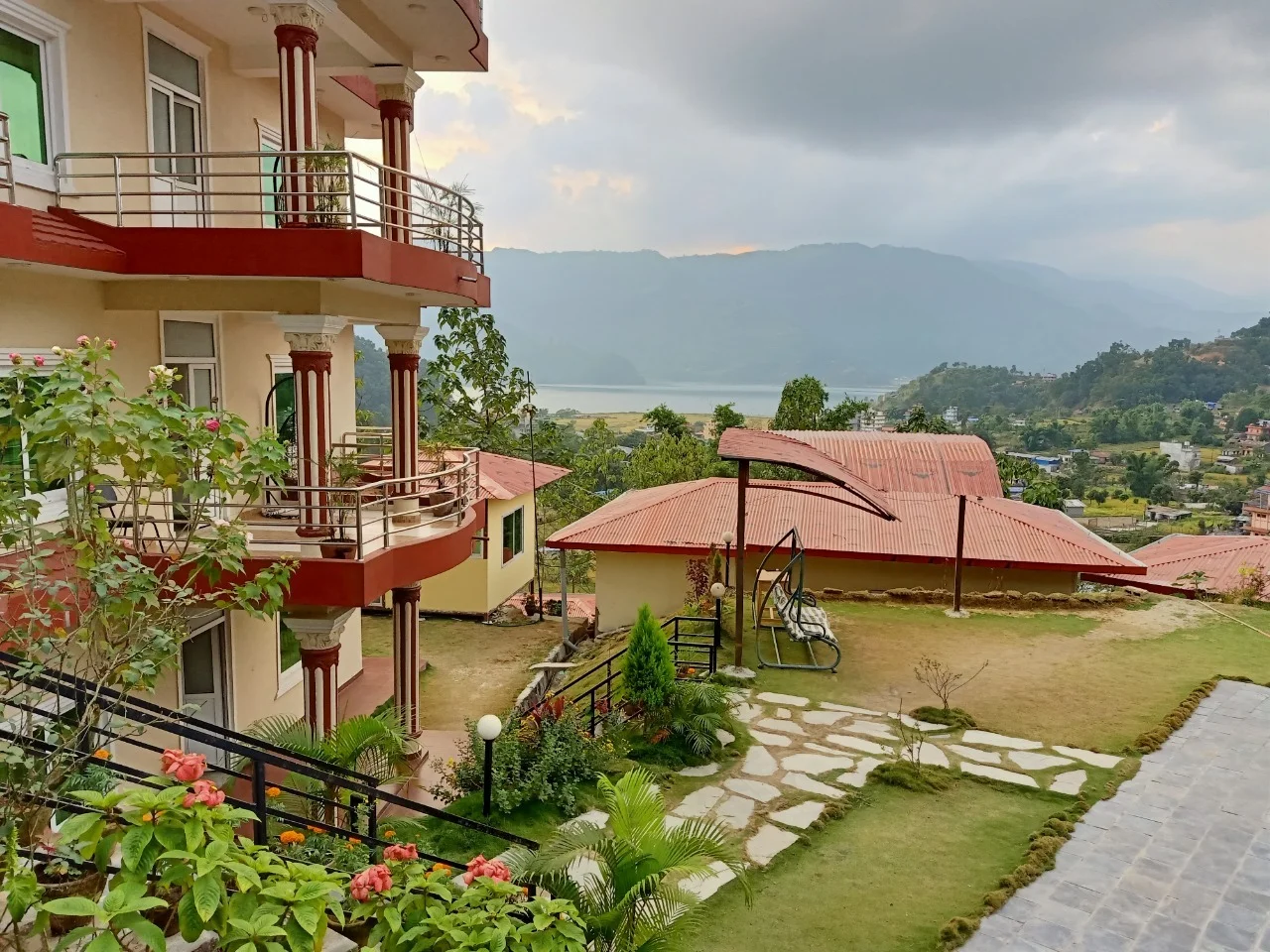
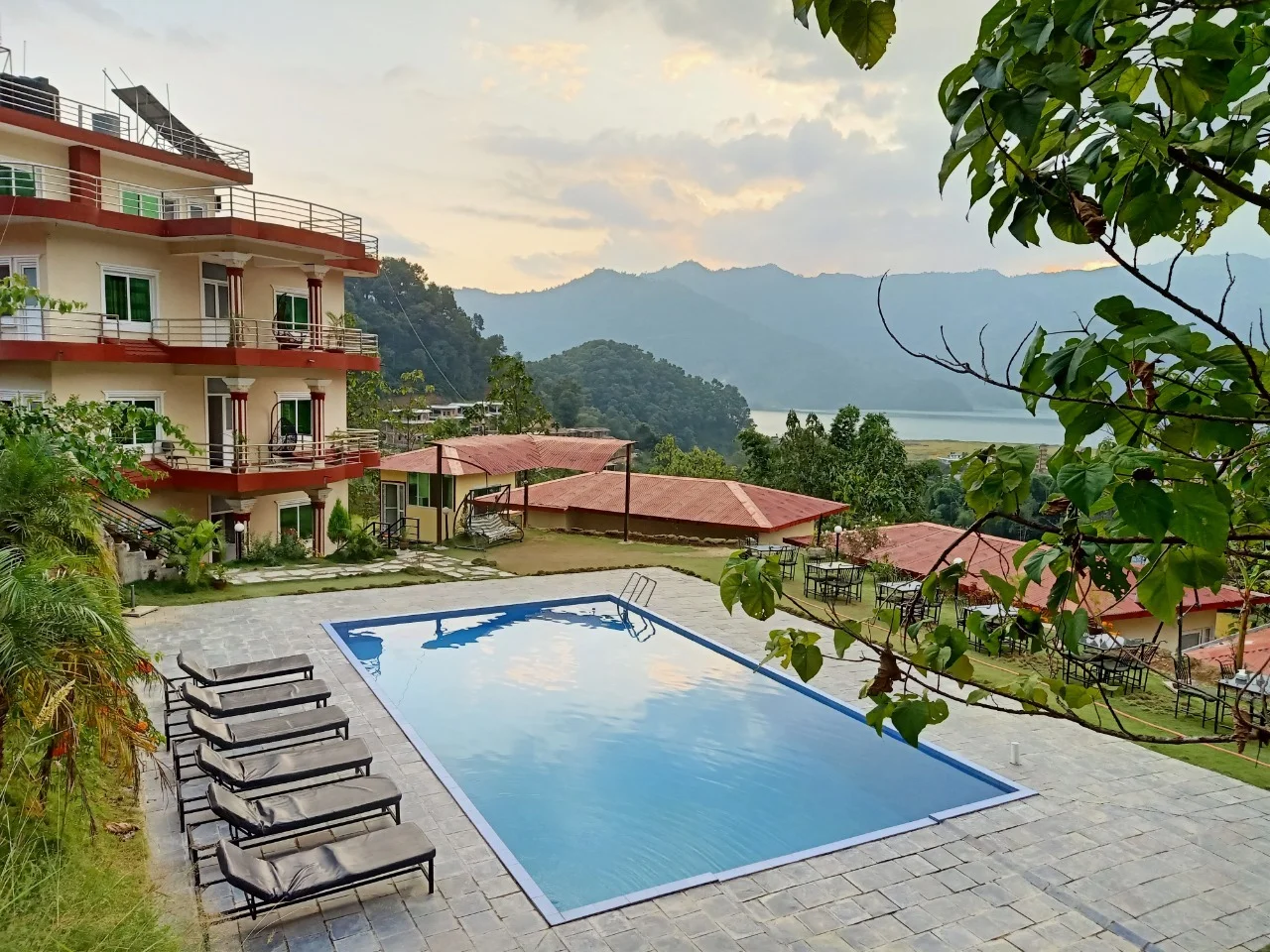
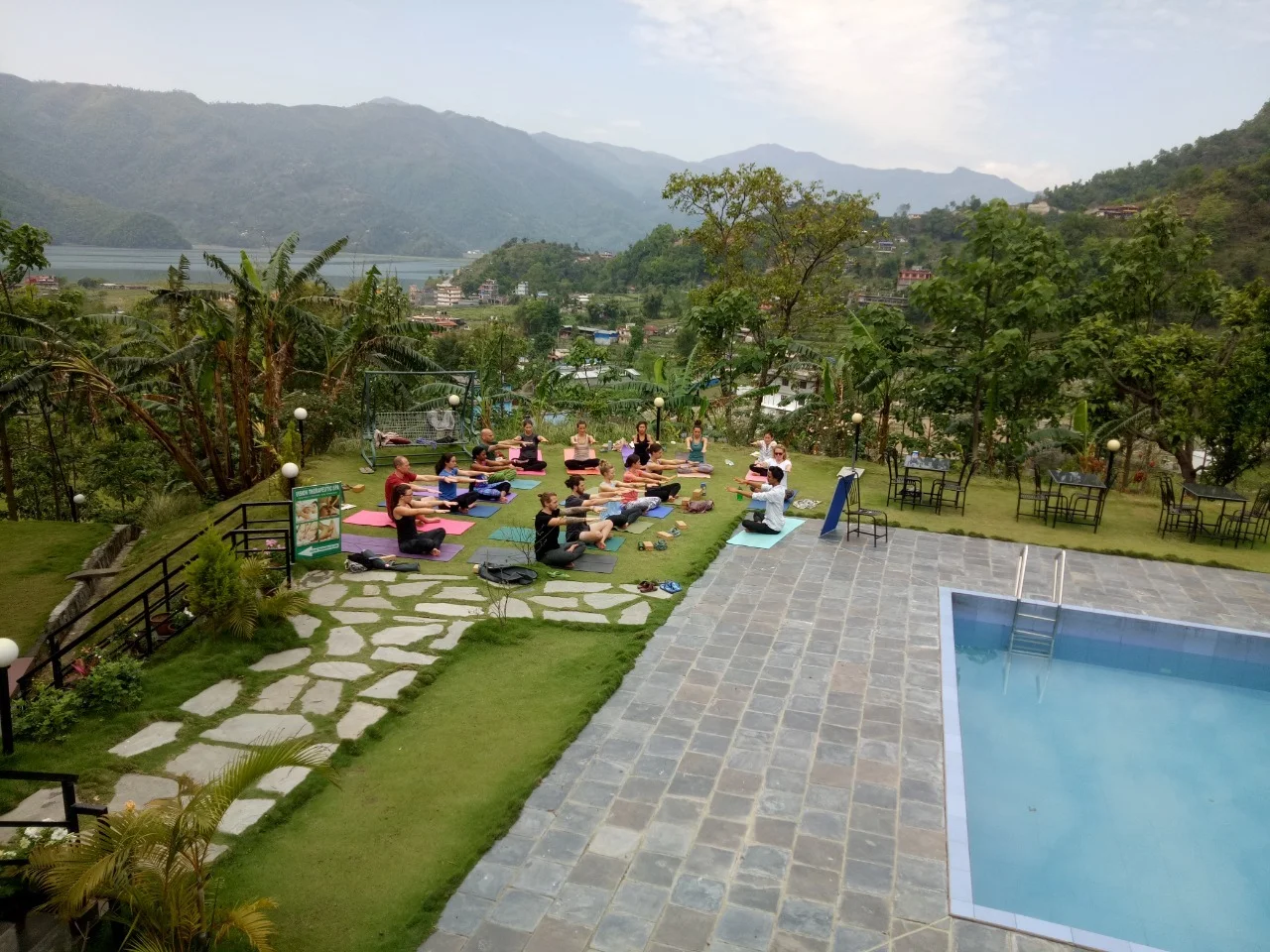
The Annapurna range is visible from the academy, giving daily practice a quiet, high-altitude backdrop.
The campus sits near Phewa Lake, one of Pokhara’s defining natural landmarks and a calm setting for practice outside the yoga hall.
Pokhara connects to Kathmandu by a roughly 25-minute domestic flight, and course costs in Nepal are generally lower than equivalent Yoga Alliance USA-registered training in Western countries.
Pokhara has grown into one of Nepal’s primary destinations for yoga teacher training, with an established base of schools, teachers, and returning international students.
Tratak Yoga Academy is registered with Yoga Alliance USA. Completing the 200-hour course leads to RYT-200 certification.
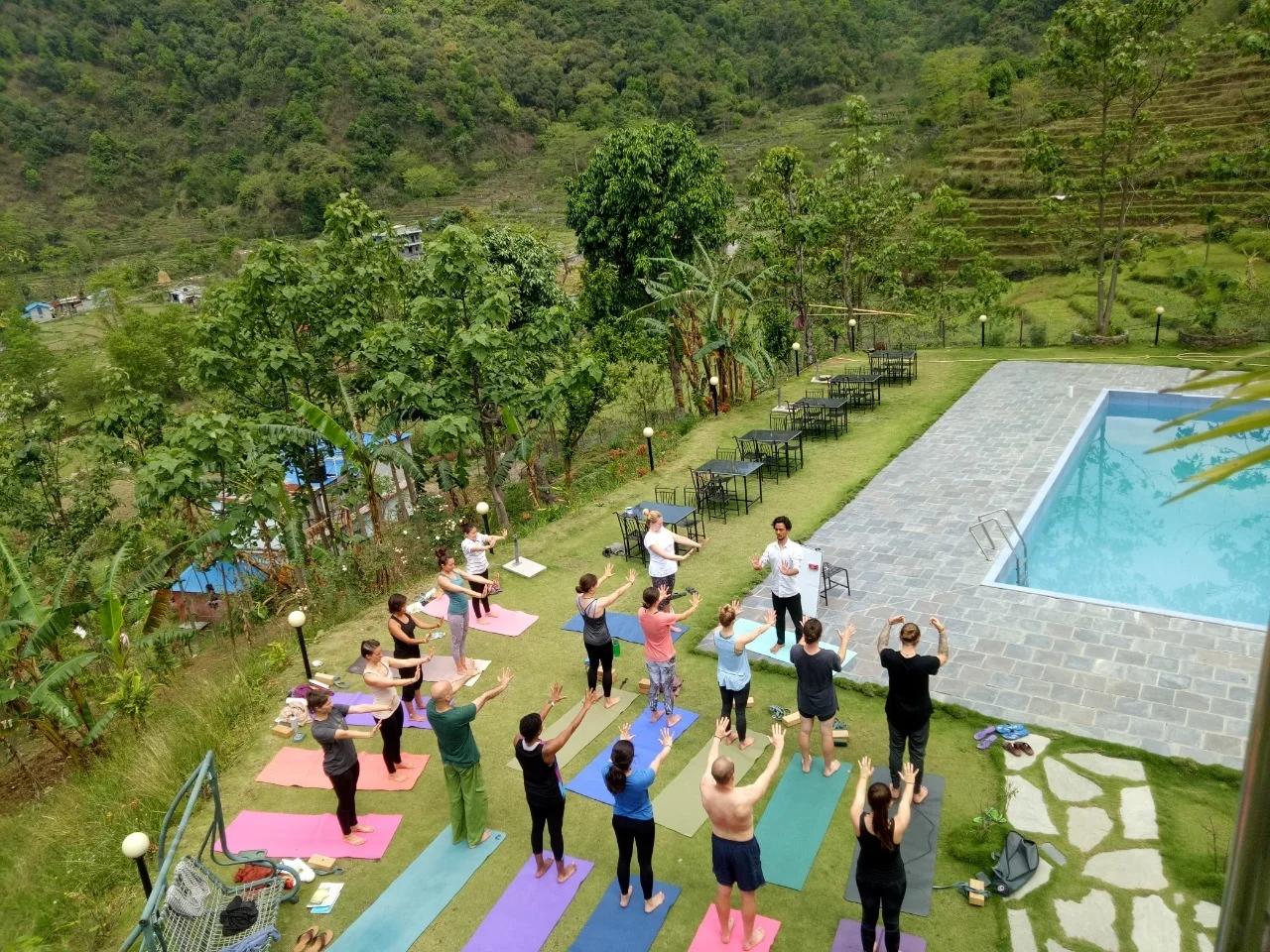
Batches are capped at 10–12 students, with a faculty of 12+ teachers across the academy’s programs.
Can’t commit to 22 consecutive days? Split the course into two 100-hour semesters, with the second completed within 36 months.
New batches start on the 7th and 15th of every month, so you’re rarely waiting long for the next intake.
The course is open to students aged 18–75, regardless of yoga background. No prior experience is required — training begins with the basics.
No prior experience needed; the course starts from fundamentals.
If you’ve completed the first 100-hour semester, this continues you toward RYT-200.
RYT-200 is the standard entry-level credential for teaching yoga professionally.
Many students join for focus, self-discovery, and a structured break from routine — not only to teach.
Psychotherapists, counsellors, and personal trainers use the course to deepen their understanding of the body–mind connection.
At Tratak Yoga Academy, Nepal, we provide a complete curriculum for RYT 200. Check out all the modules you will learn in our course.
Pranayama is the expansion and regulation of breath. In our yoga teacher training course, we provide a complete understanding and practice of various pranayama techniques. Pranayama techniques help to reduce stress, anxiety, and fat, enhance blood circulation, and improve mental clarity and concentration for people who perform them regularly in the right way.
Shatkarma is a classical purification technique used in yoga. There are five types of yogic cleaning practices that you will learn in our 100-hour yoga TTC program. It helps to clean the body and prepare you for higher practices like pranayama and meditation. In addition, it also helps to balance the body’s doshas and bring a deeper breath, work, and spiritual practice in the body.
It is one of the most dynamic and structured forms of classical Indian Yoga. It was introduced by K. Pattabhi Jois. It helps to emphasise the integration of breath, movement, and focused awareness. It is an energetic and disciplined practice that helps to sync your breath with a series of postures to detox the body and bring mental clarity.
A traditional system of physical practice to bring purity, strength, and prepare the body for higher levels of yoga. Hatha Yoga emphasises the practice of asanas combined with breath control and mindful alignment. It brings a lot of benefits, and there is a wide range of classical asanas included in Hatha Yoga.
We combine traditional Ayurveda with our yoga teacher training courses. It is one of the world’s oldest holistic healing systems from India. It helps to bring overall well-being by balancing the harmony between mind, body, and soul. By understanding Ayurveda philosophy and principles, students gain deeper insight into their own constitution and overall well-being. Incorporating Ayurvedic practices in yoga can help to improve vitality, balance, and long-term health.
Meditation is a mental practice of focusing your attention and awareness to achieve calm, emotional stability, and mental clarity. Constant practice of meditation brings mental stability, emotional balance, and a sense of calmness. It helps to move forward to a higher state of consciousness and self-realisation. Meditation looks easy, but you need a meditation technique to deepen your experience. There are so many types of meditation in our 100-hour YTTC course.
This module covers the traditional philosophy, concepts, and history of yoga, aligned with insights from modern research. It helps to understand yoga as a holistic way of life and brings it into a contemporary lifestyle. You will learn the true purpose of yoga beyond just physical poses – after all, it is a holistic way of life.
In our 100-hour YTTC program, we also provide teaching skills to practitioners through practical sessions so they can instruct their students correctly. We focus on building confidence, communication skills, and the ability to guide others effectively through teaching practice. It will help you prepare to teach with clarity, confidence, and authenticity.
Teaching Practice – Core Components
A good yoga teacher is not just a skilled practitioner. It is someone who can plan, communicate, and create a supportive learning environment. In this module, you will learn how to apply practical teaching methodology to deliver a well-structured, safe, and transformative yoga class.
Mudra is a powerful yogic gesture performed by the hands. It is also known as a divine gesture because it influences the flow of energy within the body. Mudras have been practised for years to balance the mind, vitality, and support overall physical and mental well-being. There are so many types of Mudra, and each Mudra works by activating specific energy channels within the body.
Mantra chanting is a meditative practice that involves the rhythmic and continuous repetition of certain words or sounds. It is a yogic practice that uses sacred sound and vibration to calm the mind and create a deep connection with the universe. There are so many mantras that help to transform your inner strength and bring peace, clarity, and harmony in the body.
Completing the 200 hours — in one continuous 22-day block or across two semesters — leads to an RYT-200 certificate registered with Yoga Alliance USA. A graduation ceremony follows the 22-day course.
What RYT-200 allows:
Certification confirms training completion and Yoga Alliance registration — it doesn’t guarantee employment, students, or income, and none of that is claimed here.
If 22 consecutive days isn’t realistic for your schedule, the 200 hours can be split:
Semester | Hours | Timing |
|---|---|---|
Semester 1 | 100 hours | Book any available monthly batch |
Semester 2 | 100 hours | To be completed within 36 months of Semester 1 |
Both semesters can be completed at either the Pokhara or the Rishikesh campus. On completing both, you receive the same RYT-200 certification as students who complete the course in one continuous block. This structure suits working professionals, parents, or anyone who can’t take three uninterrupted weeks off in one go
Curriculum, faculty standards, batch size, and Yoga Alliance certification are the same at both campuses. The difference is environment:
Annapurna Himalayan views, Phewa Lakeside setting, a quieter international-student town.
On the Ganges, in India’s established yoga capital, with a more built-up spiritual-tourism scene.
Both can also be combined through the flexible semester structure — for example, Semester 1 in Pokhara and Semester 2 in Rishikesh.
Teaching practice runs through the course rather than being confined to the final days. Training starts with short, 5-minute teaching segments in front of peers and builds toward leading full class sequences, covering:
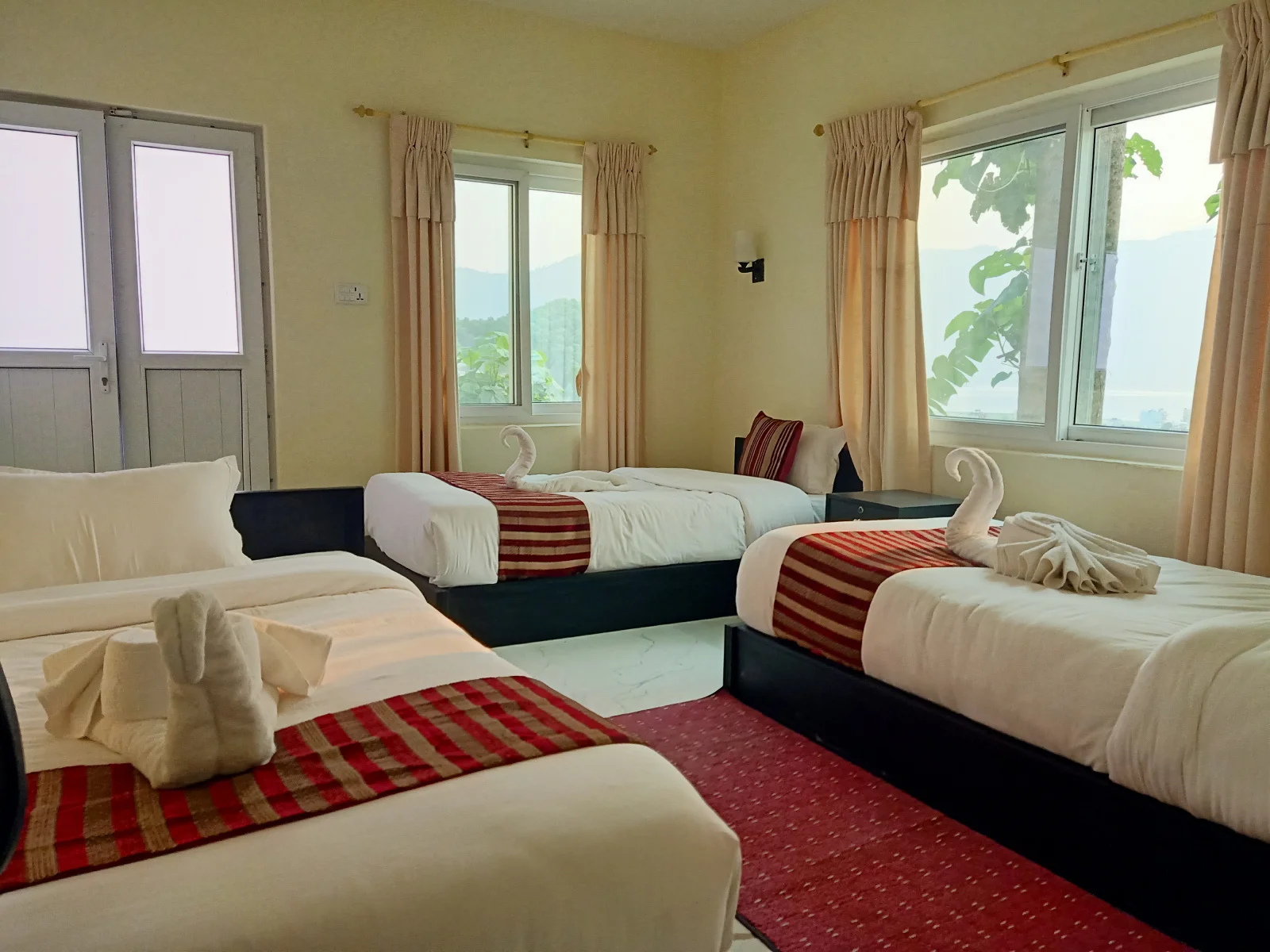
Rooms are shared or private, each with an attached bathroom. Three Sattvic vegetarian meals are served daily — breakfast, lunch, and dinner — prepared without onion, garlic, caffeine, or alcohol, in line with a traditional yogic diet. This is presented as the traditional dietary approach for the program, not as a medical treatment.
Most international students fly into Tribhuvan International Airport, Kathmandu, then take a roughly 25-minute domestic flight to Pokhara Airport. Complimentary pickup is provided from Pokhara Airport and Pokhara Bus Station. Plan to arrive in Pokhara one day before your course start date.
Total travel time and specific flight connections vary significantly by home country — treat any door-to-door duration as an estimate, not a guarantee.
Most nationalities can obtain a visa on arrival at Tribhuvan International Airport, Kathmandu. Indian passport holders do not require a visa. You can also apply online in advance at online.nepalimmigration.gov.np.
Visa rules and fees change. International students should verify current visa requirements and fees with Nepal’s official Department of Immigration before travel, rather than relying on fees quoted on this page.
Our 200-hour yoga teacher training in Pokhara is genuinely all-inclusive. The prices below cover everything you need for 22 days of training. There are no surprise charges on arrival.
At Tratak Yoga Academy, our faculty is the heart of our training program. Meet our trainer and know their expertise.
Explore some of our students' transformative journeys they get from our yoga teacher training in Pokhara, Nepal.

Remarkable experience .They go extra miles to educate students

 Rajne Malhotra – International Yoga Instructor
The Calm environment and experienced teachers make’s you feel something new to learn. The Stay was great with all the amenities and with good food which builds strength to do… read more yoga🙏 Thankyou to the school for giving me great experience in learning yoga 🧘
 SandhyaSri Mahesh
They have very calm, hygien and perfect ambience for yoga. Especially the teachers in this yoga school are specialised in their field and are concern for all students.
 Saurabh Verma
Hi, I am Khushboo. I went to Tratak Yoga Academy for the 50-hour Aerial Yoga course. I had a very good experience with Aerial Yoga. Especially Vishal Sir, who taught… read more us in a very simple and easy-to-understand way. The teachers here are very knowledgeable. I really liked the food and accommodation, and the environment was very pleasant. Special thanks to Jai Sir, who has designed Tratak Yoga Academy so beautifully
 Khushboo singh
Excellent experience
 Jyotsna Redla
I recently completed a face yoga course with Tratak Yoga, and I highly recommend it. The guidance and support provided throughout the entire course were truly exceptional.
 Maya
MayaThis was a great training and was really helpful for me and was a very fun experience. I definitely recommend this training if anyone is interested.
 Shreeya Cheedhalla
Attended face yoga online 15h training . Training is covering all aspects of face yoga , from cttm care routine , anatomy , as well deep specifics on ingredients within… read more a products should be there for different types of skin and Environment. I liked very face exercises and face massage . I hope now have good knowledge to share it further. Many thanks, for the good organized training. 🙏
 Mili M
The Face. Yoga course is excellent. The teacher mixes theory and practice very well. She explains clearly and is very patient. Jay is a great manager — he answers our… read more questions quickly. I really appreciate the course and highly recommend it.
 Marcela Dâmaris
No prior yoga experience is required. Our 200-hour program is specifically designed to welcome complete beginners. We begin with fundamental principles and build progressively. Our small batch size (maximum 12 students) ensures every beginner receives personal guidance and individual attention throughout.
Tratak Yoga’s all-inclusive 200-hour yoga TTC in Pokhara starts from $1,200 USD for a shared room and $1,600 USD for a private room. This includes 22 nights’ accommodation, three Sattvic meals daily, all study materials, airport pickup, weekly excursions, and lifetime community support.
The curriculum, faculty standards, batch size, and Yoga Alliance certification are identical at both locations. The primary difference is environment and setting — Pokhara offers Annapurna Himalayan views and Phewa Lakeside; Rishikesh offers the sacred Ganges riverside and the energy of India’s yoga capital. Both locations can be combined through our flexible semester structure.
We offer a flexible semester structure. Complete Semester 1 (100 hours) now and return for Semester 2 within 36 months — at our Nepal or our Rishikesh, India campus. You receive the identical Yoga Alliance RYT 200 certification on completing both semesters. The flexibility is built in so life does not prevent certification.
Yes. Pokhara is consistently rated as one of the safest cities in Nepal for solo travellers, including solo female students. Tratak Yoga’s campus has 24/7 CCTV security, a residential ashram setting, and a strongly supportive student community. Every month, many solo female students join our training programs from around the world.
Yes. Most nationalities receive a visa on arrival at Tribhuvan International Airport, Kathmandu, including visitors from the USA, UK, Australia, Canada, and most European countries. For the smoothest arrival experience, we recommend applying online in advance at https://online.nepalimmigration.gov.np/tourist-visa. Indian passport holders do not require a visa.
Sattvic food is a purely vegetarian diet that avoids onion, garlic, caffeine, and alcohol. It is traditionally considered the ideal food for yoga practitioners — light, nourishing, and supportive of mental clarity and physical energy. All three daily meals provided at Tratak Yoga are freshly prepared Sattvic vegetarian meals.
Our 200-hour program is open to students aged 18 to 75. We have successfully trained students across all age groups. Yoga is accessible at any age — if you have specific health concerns, please consult your doctor and inform us at registration so we can support you appropriately.
Yes. Teaching practice is a core component of the 200-hour curriculum. From the early days of training you will begin practising teaching in front of your peers — starting with short 5-minute segments and building to full class sequences. You will learn how to demonstrate asanas correctly, give clear verbal alignment cues, manage class energy, and build genuine teaching confidence.
September through April is the most popular season for yoga training in Pokhara — the weather is pleasant, the Annapurna Range is clearly visible, and the lakeside environment is at its most beautiful. October and November in particular offer exceptional mountain visibility. We run training year-round with comfortable indoor facilities available during the warmer and monsoon months.
Fly from your home country to Tribhuvan International Airport, Kathmandu (most international carriers connect via Dubai, Doha, Singapore, or Delhi). From Kathmandu, take a 25-minute domestic flight to Pokhara Airport. We will meet you at Pokhara Airport with a complimentary pickup. Total travel time from Canada is typically 20–24 hours including layovers.
Absolutely. Many students at Tratak Yoga join the 200-hour training for personal transformation — to reduce stress, heal from burnout, improve physical health, deepen meditation, or experience authentic yogic living. A professional certification is a welcome outcome but not the only valid reason to join.
Yes — shared or private room with attached bathroom is included in both price tiers.
Yes, complimentary pickup from Pokhara Airport and Pokhara Bus Station is included in the course fee.
We are one of the top most reputed yoga schools in Pokhara, Nepal and Rishikesh, India. The moto of our school is to spread Traditional and authentic yoga teacher training courses.
+91 88266 06304
jai.tratak@gmail.com