Choosing the Right Yoga Teacher Training Course: A Practical Guide
Every year, tens of thousands of practitioners decide to take their personal yoga practice a step further and enroll in a yoga teacher training course. Some are chasing a career change. Others simply want to understand their own practice more deeply, with teaching almost a side effect of that curiosity. Whatever the motivation, the decision of which course to join is one of the most consequential choices a practitioner will make — and it’s also one of the most confusing, because the yoga training industry has grown faster than the standards meant to govern it.
A quick search for “yoga teacher training” returns thousands of options, ranging from rigorous, decades-old institutions to loosely organized programs assembled around a nice location and a marketing budget. Distinguishing between them requires more than checking star ratings. It requires understanding what actually makes a training legitimate, effective, and worth your time and money.
This guide walks through exactly that — not as a sales pitch for any single format, but as an honest framework for evaluating any yoga teacher training course, anywhere in the world.
Key Takeaways
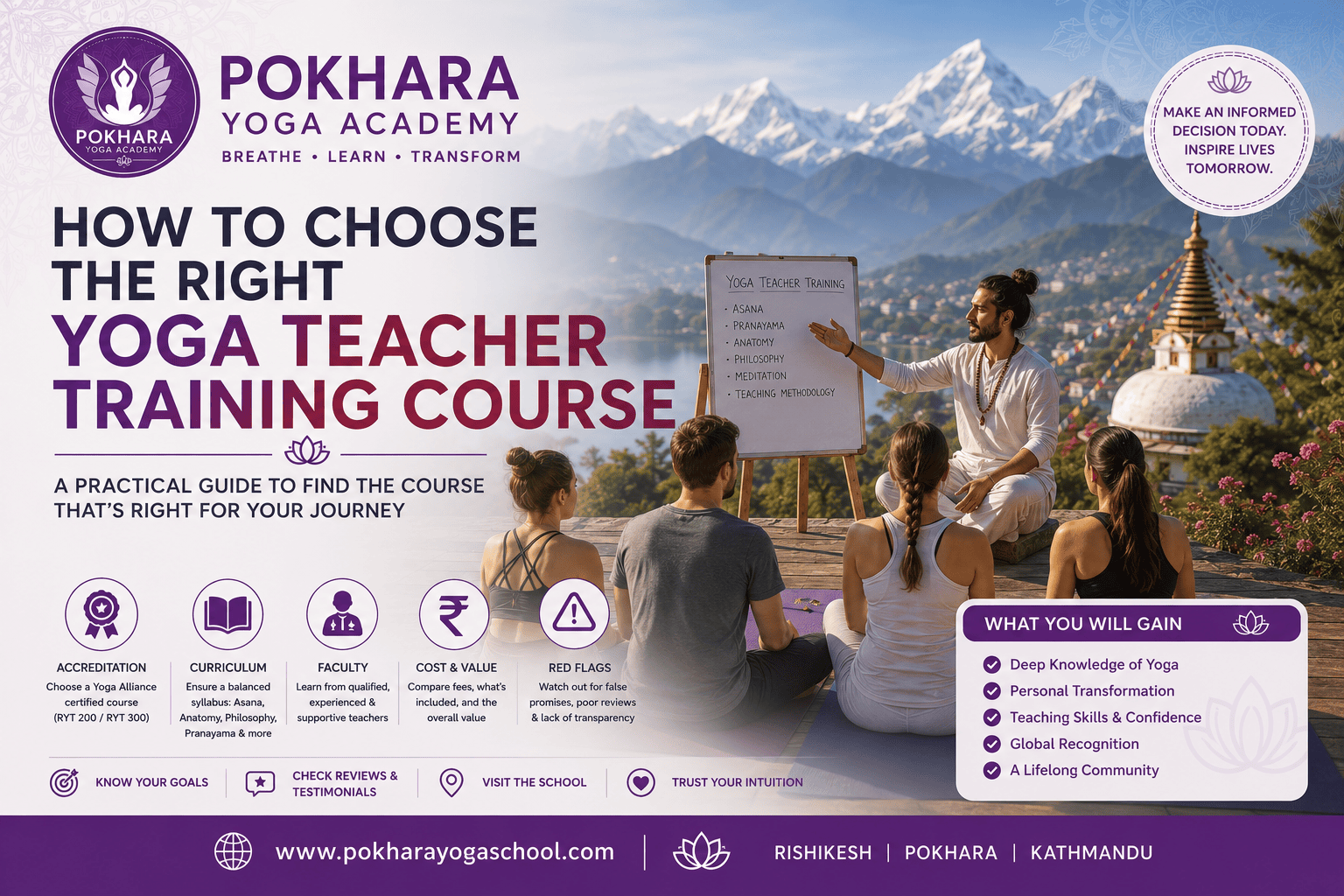
- A legitimate yoga teacher training course should be built around a transparent curriculum covering asana, pranayama, philosophy, anatomy, and teaching methodology — not just physical practice.
- Yoga Alliance registration (RYT-200, RYT-300, RYT-500) is the most widely recognized international accreditation, but it should always be independently verified, not taken at face value.
- Faculty credentials matter more than location photos — ask who is actually teaching, their lineage, and their years of experience before enrolling.
- Course format (in-person, online, or hybrid) should match your learning style and life circumstances, not simply what’s trending.
- Total cost should be evaluated against what’s actually included — accommodation, meals, study materials, and post-certification support — not just the headline price.
- Red flags include vague curricula, unverifiable credentials, no mention of practicum teaching hours, and an unwillingness to share a detailed daily schedule before you enroll.
Why Choosing the Right Course Matters More Than It Seems
A Teacher Training Shapes How You Teach for Years
The training you complete becomes the foundation of your teaching voice. Alignment cues, sequencing habits, the way you explain philosophy to students, even your instincts around safety and adjustments — much of this traces directly back to your original teacher training experience. A rushed or superficial program can leave graduates technically certified but genuinely underprepared to guide a room full of students safely and confidently.
The Certificate Alone Isn’t the Point
It’s tempting to treat the certificate as the finish line, but a serious teacher training should leave you meaningfully more capable than you were before you started — not just credentialed. This distinction matters enormously when it comes to actually finding teaching work, where studios, retreat centers, and online platforms increasingly look past the certificate itself to assess whether a teacher can actually hold space, sequence intelligently, and explain concepts clearly.
The Financial and Time Investment Is Real
A 200-hour teacher training typically represents a commitment of three to four weeks of full-time study, plus travel, accommodation, and program fees that can range from a few hundred to several thousand dollars depending on location and format. This is not a decision to make on discount pricing or a well-shot Instagram reel alone.
Step One: Understand the Different Levels of Yoga Teacher Training
100-Hour Yoga Teacher Training
A foundational, introductory format, often chosen by dedicated practitioners who want deeper knowledge of alignment and philosophy without necessarily pursuing full certification, or as a first step before a full 200hr program. It typically doesn’t qualify a graduate for independent Yoga Alliance registration on its own.
200-Hour Yoga Teacher Training (RYT-200)
The internationally recognized entry-level credential for teaching yoga professionally. A genuine 200hr program covers technical asana practice and alignment, pranayama and breathwork, meditation, yoga philosophy (commonly drawing on the Yoga Sutras of Patanjali), anatomy and physiology, teaching methodology, and supervised practicum teaching hours. Graduates of a Yoga Alliance-registered 200hr program can register as an RYT-200.
300-Hour Yoga Teacher Training (RYT-300)
An advanced-level program for those who already hold a 200hr certification, deepening expertise in areas like advanced asana, subtle body anatomy, therapeutic applications, or specialized teaching populations. Completing both 200hr and 300hr levels allows registration as an RYT-500 with Yoga Alliance.
Specialized Trainings
Beyond the standard levels, many schools offer specialized certifications in areas like prenatal and postnatal yoga, yoga therapy, meditation teaching, or sound healing. These are typically pursued after a foundational 200hr certification, as an added specialization rather than a replacement for it.
Step Two: Decide on the Right Format for Your Life
In-Person, Immersive Training
An immersive residential program — typically three to four weeks at a dedicated ashram or yoga school — offers the deepest and most transformative experience for most students. Being fully removed from daily distractions, living alongside fellow trainees, and following a structured daily rhythm accelerates both learning and personal transformation in a way that’s difficult to replicate part-time.
Online Yoga Teacher Training
Online programs have matured significantly and now offer legitimate, Yoga Alliance-recognized certification for students who cannot take three to four weeks away from work or family obligations. The trade-off is the loss of the immersive residential experience — the shared meals, the accountability of a physical cohort, the cultural context of training in a place like Rishikesh or Kathmandu. For many working professionals, however, online training is the only realistic path to certification, and a well-designed program can still deliver rigorous instruction.
Hybrid Formats
Some schools now offer hybrid programs — combining online theoretical coursework with a shorter in-person intensive for practicum and hands-on instruction. This format can offer a reasonable middle ground for students who want some immersive experience without a full month away from home.
Weekend and Modular Training
Spread across several weekends or months, modular training suits students who want an in-person experience but cannot commit to a continuous block of time. It typically takes considerably longer to complete than an immersive residential program but offers more flexibility for those balancing work or family commitments.
Step Three: Evaluate Accreditation Properly
What Yoga Alliance Registration Actually Means
Yoga Alliance USA is the most widely recognized credentialing body for yoga teacher training internationally. A school registered with Yoga Alliance has demonstrated that its curriculum meets minimum hour and content requirements across the core educational categories — techniques, anatomy, philosophy, and teaching methodology. Graduates of a registered program become eligible to register individually as an RYT (Registered Yoga Teacher).
How to Actually Verify a School’s Accreditation
Never take a Yoga Alliance badge at face value. Search the school’s name directly on Yoga Alliance’s official directory to confirm active registration, since badges can be outdated, misapplied, or, in rare cases, used without genuine registration. This single verification step takes less than five minutes and eliminates one of the most common sources of disappointment among new teachers.
Regional and National Accreditation
In addition to Yoga Alliance, some countries maintain their own credentialing bodies — for example, India’s Yoga Certification Board (YCB) under the Ministry of AYUSH. These can add a valuable layer of local legitimacy, particularly for teachers planning to work within that country’s wellness or medical tourism sector, though they don’t automatically substitute for international recognition if you intend to teach globally.
Step Four: Investigate the Faculty Before You Investigate the Brochure
Ask Who Is Actually Teaching You
A trustworthy program will name its lead teachers individually, along with their training lineage, years of teaching experience, and specific areas of specialization. If a website emphasizes stunning location photography far more than instructor biographies, that imbalance itself is worth noting.
Look for Depth Across Disciplines
A single generalist teacher covering asana, philosophy, and anatomy alone is a warning sign for a serious program. Look for faculty with distinct specializations — a dedicated anatomy instructor, a philosophy teacher with genuine scriptural study behind them, an experienced senior teacher overseeing practicum and adjustments.
Read Between the Lines of Testimonials
Genuine student testimonials tend to mention specific teachers, specific moments of learning, or specific ways their teaching improved — not just the beauty of the location or the quality of the food. Testimonials that read like generic travel reviews are a signal to dig deeper before enrolling.
Step Five: Scrutinize the Curriculum, Not Just the Marketing
Request a Full Daily Schedule
Before enrolling in any program, ask directly for a detailed, hour-by-hour schedule covering the entire course. A credible 200hr curriculum should show clear time allocated to philosophy, anatomy, and teaching methodology — not a schedule dominated almost entirely by asana practice with everything else compressed into a single afternoon.
Confirm Practicum Teaching Hours Are Included
A genuine teacher training should include supervised practicum time, where trainees actually practice teaching — cueing, sequencing, and adjusting real students or fellow trainees — under experienced supervision. Programs that skip this step are producing graduates who understand yoga personally but haven’t actually practiced the skill of teaching it.
Check How Philosophy Is Taught
Philosophy shouldn’t be reduced to a single lecture on the Yamas and Niyamas. Look for programs that engage seriously with foundational texts like the Yoga Sutras of Patanjali or the Hatha Yoga Pradipika, and that connect philosophical concepts back to practical teaching and daily life, rather than treating philosophy as an obligatory add-on.
Anatomy and Safety Standards
Confirm that the anatomy component covers not just muscle names but practical application — contraindications, common injuries, and how to modify poses safely for different bodies. This is one of the areas most likely to be under-taught in weaker programs, and it directly affects your ability to teach safely once certified.
Step Six: Understand the Full Cost, Not Just the Headline Price
What Should Typically Be Included
A transparent program will clearly list what’s included in its stated fee — accommodation, meals, study materials, and any certification fees — rather than surprising students with add-on costs after enrollment. Ask specifically whether airport transfers, excursions, or additional certification paperwork carry separate charges.
Comparing Cost Across Locations and Formats
Training costs vary significantly by country and format. Programs based in South Asia, including India and Nepal, are frequently more affordable than equivalent Western programs due to lower regional living costs — not because of reduced curriculum quality. Online programs typically cost less than immersive residential ones, reflecting the absence of accommodation and meal costs, but shouldn’t be dramatically cheaper if the actual teaching hours and instructor access are genuinely comparable.
Watching for Underpriced Red Flags
A price that seems unusually low relative to comparable programs is worth investigating rather than celebrating. It can indicate compressed curriculum hours, inexperienced or unpaid instructors, or hidden costs that emerge after enrollment.
Step Seven: Consider What Happens After Certification
Does the School Offer Continuing Support?
The strongest yoga schools maintain genuine alumni communities, continuing education opportunities, or mentorship as new teachers begin their careers. A program that treats graduation as a clean endpoint, with no further engagement, often reflects a transactional approach to teacher training rather than a genuine investment in producing capable teachers.
Pathways to Advanced Certification
If you anticipate wanting to pursue a 300hr or 500hr certification eventually, it’s worth checking whether your chosen school offers a clear pathway to that next level, either directly or through a recognized partner institution.
Common Red Flags to Watch For
- Vague or unavailable curriculum details before enrollment.
- No verifiable Yoga Alliance registration, or a badge that doesn’t match the school’s actual listed name in the official directory.
- No mention of supervised practicum teaching hours anywhere in the program description.
- Instructor bios that are missing, generic, or unverifiable.
- Pricing significantly below the market average with no clear explanation.
- Pressure tactics — countdown timers, urgency-driven discounts, or aggressive upselling before you’ve even reviewed the curriculum.
- No clear cancellation or refund policy in writing.
A Simple Decision Framework
For practitioners feeling overwhelmed by the number of options, a simple sequence of questions can cut through most of the noise:
- Is this school’s Yoga Alliance registration verifiable directly on Yoga Alliance’s website?
- Can I see a detailed, hour-by-hour curriculum before enrolling, not just a course overview?
- Are the lead instructors named individually, with genuine, checkable credentials?
- Does the curriculum include supervised practicum teaching hours?
- Is the total cost, including accommodation and materials, transparent and itemized?
- Does the school offer any form of support or community after certification?
If a program can answer all six of these clearly and confidently, it has cleared the most important bar. If it hesitates, deflects, or can’t answer directly, that hesitation is itself useful information.
Frequently Asked Questions About Choosing a Yoga Teacher Training Course
Q: What is the most important factor when choosing a yoga teacher training course?
Verified accreditation and curriculum transparency matter most. A program registered with Yoga Alliance, with a detailed, hour-by-hour curriculum and named, credentialed faculty, is far more likely to deliver genuine teaching competence than one selected purely for its location or price.
Q: Is a 200-hour yoga teacher training enough to start teaching?
A: Yes, a Yoga Alliance-registered 200-hour program is the internationally recognized standard entry-level qualification for teaching yoga professionally, allowing graduates to register as an RYT-200 and begin teaching group or private classes.
Q: Should I choose an online or in-person yoga teacher training?
A: In-person, immersive training generally offers a deeper and more transformative learning experience through full daily immersion and hands-on practicum, while online training offers genuine flexibility for students who cannot take an extended period away from work or family. The right choice depends on your circumstances, not simply which format is trending.
Q: How much does a yoga teacher training course typically cost?
A: Costs vary considerably by country, format, and inclusions. Programs in South Asia, including India and Nepal, are frequently more affordable than equivalent Western programs due to regional cost differences, not reduced quality, while online courses typically cost less than immersive residential programs. It’s best to request an itemized cost breakdown directly from any school under consideration.
Q: How do I verify if a yoga school is genuinely Yoga Alliance accredited?
A: Search the school’s exact name directly on Yoga Alliance’s official online directory to confirm active registration, rather than relying on a badge or logo displayed on the school’s own website, which may be outdated or inaccurate.
Q: What’s the difference between RYT-200 and RYT-500?
A: RYT-200 reflects completion of a 200-hour Yoga Alliance-registered teacher training, the standard entry-level credential. RYT-500 reflects completion of both a 200-hour and an additional 300-hour registered training, representing a more advanced level of certified teaching education.
Q: Can I become a yoga teacher without any prior teaching experience?
A: Yes. Most 200-hour teacher trainings are designed for dedicated practitioners rather than experienced teachers, and include supervised practicum sessions specifically to build teaching skills and confidence from the ground up during the course itself.
Q: How long does it take to complete a yoga teacher training course?
A: An immersive residential 200-hour program typically takes three to four weeks of full-time study, while online or modular formats can take several months, depending on the pace and structure of the specific course.
Final Thoughts: Choose the Course That Builds a Real Teacher, Not Just a Certificate
The right yoga teacher training course does more than hand you a certificate at the end of a few weeks. It shapes how you cue a pose, how you hold space for a struggling student, how you understand the philosophy underneath the physical practice, and how confidently you step into a room to teach for the first time. That kind of foundation is worth being selective about.
Take the time to verify accreditation directly, ask for a genuine curriculum breakdown, learn who is actually teaching you, and look honestly at the full cost and what it includes. A program that welcomes those questions, rather than deflecting them, has already told you most of what you need to know.
Pokhara Yoga Academy offers Yoga Alliance-registered 100hr, 200hr, 300hr, and 500hr teacher training programs across Rishikesh, Pokhara, and Bali, along with a fully accredited online school, giving practitioners a transparent, credible path into professional teaching in the format that fits their life.



Comments are closed