
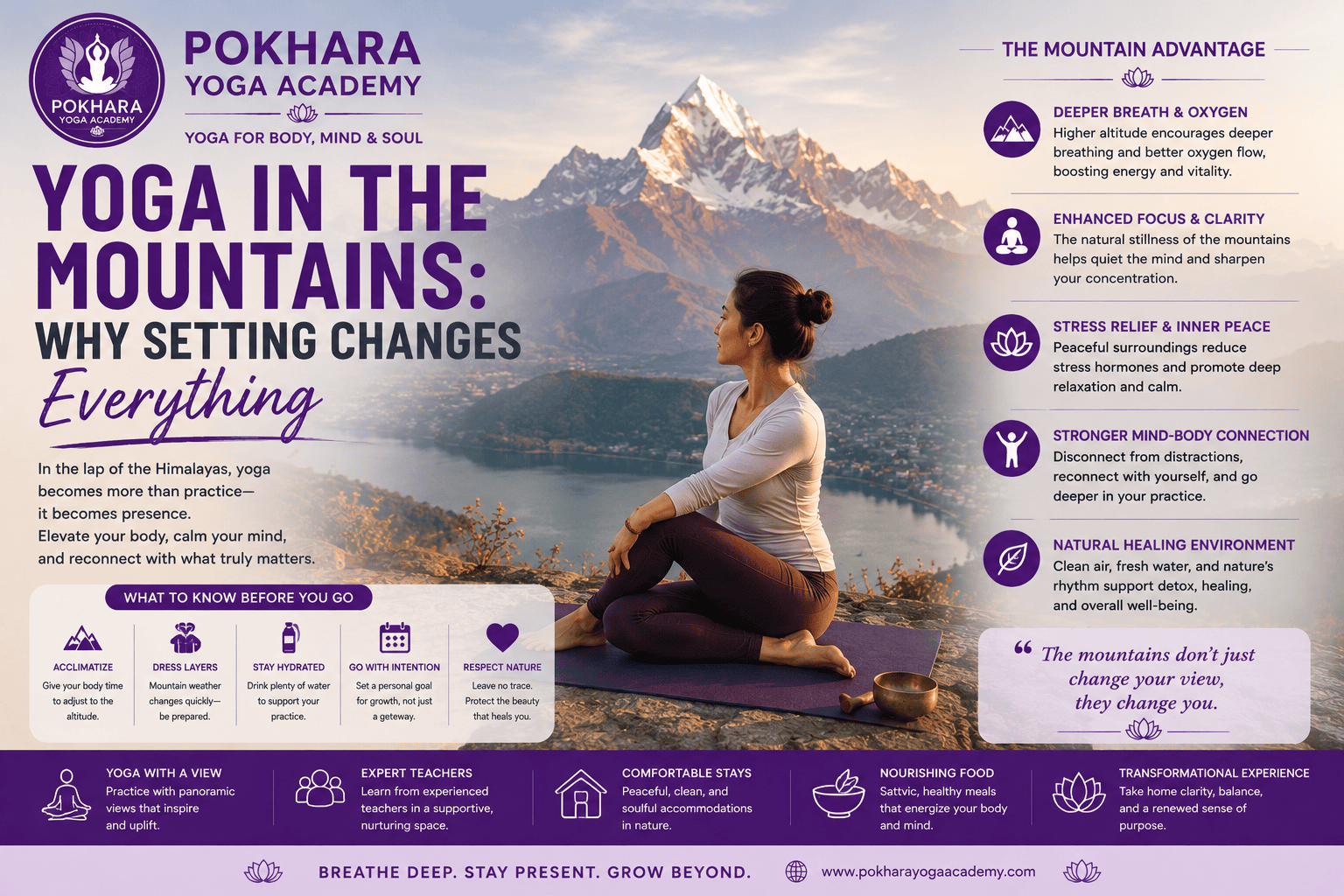
Yoga in the Mountains: Why the Setting Changes Everything
There’s a specific, hard-to-name shift that happens the first time someone practices Savasana with an actual mountain range visible through an open window, rather than a studio ceiling or a phone screen playing nature sounds. It’s not that the pose changes. It’s that something in the nervous system seems to recognize scale — genuine, undeniable, physical scale — in a way that no visualization cue can replicate.
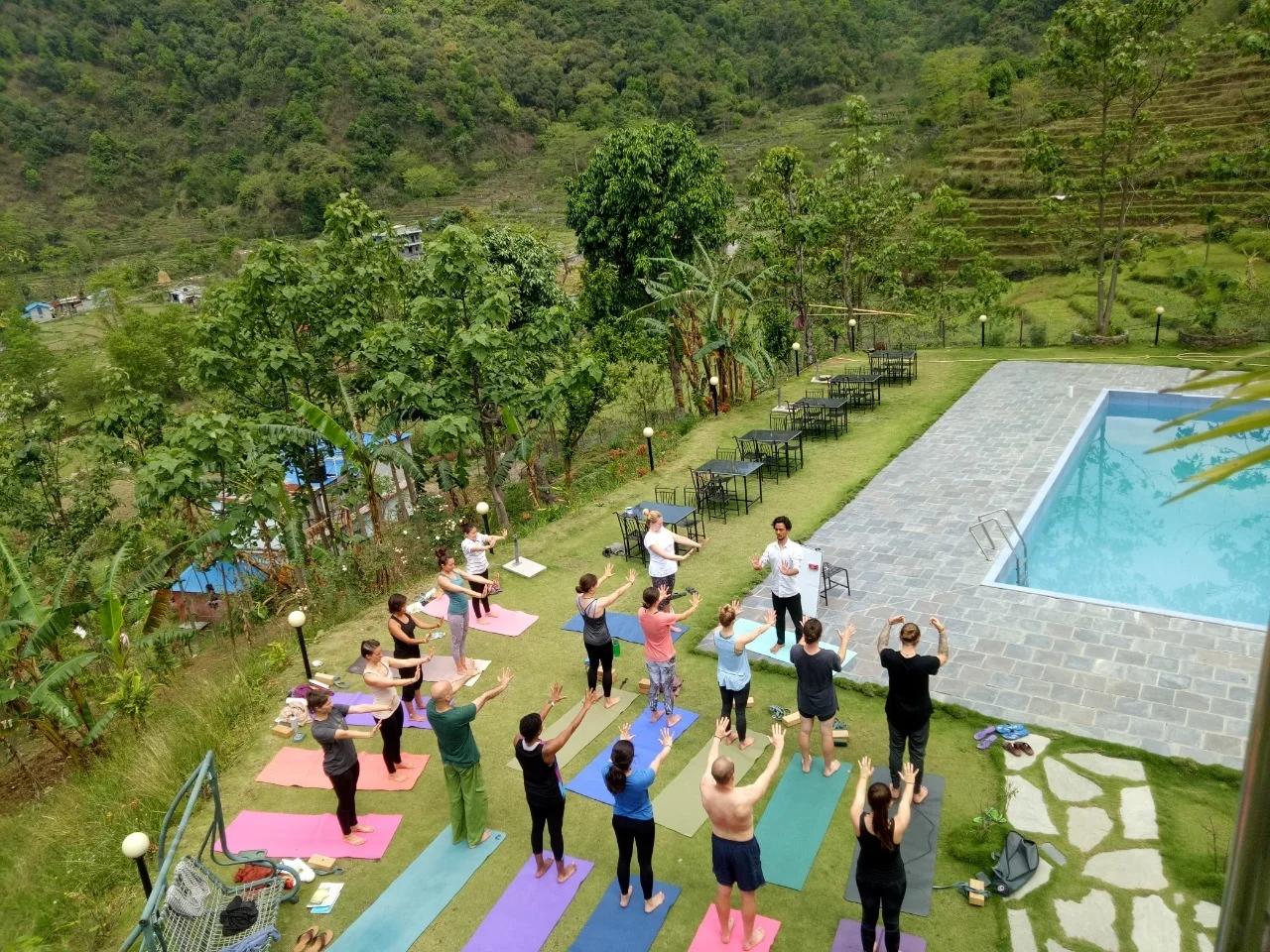
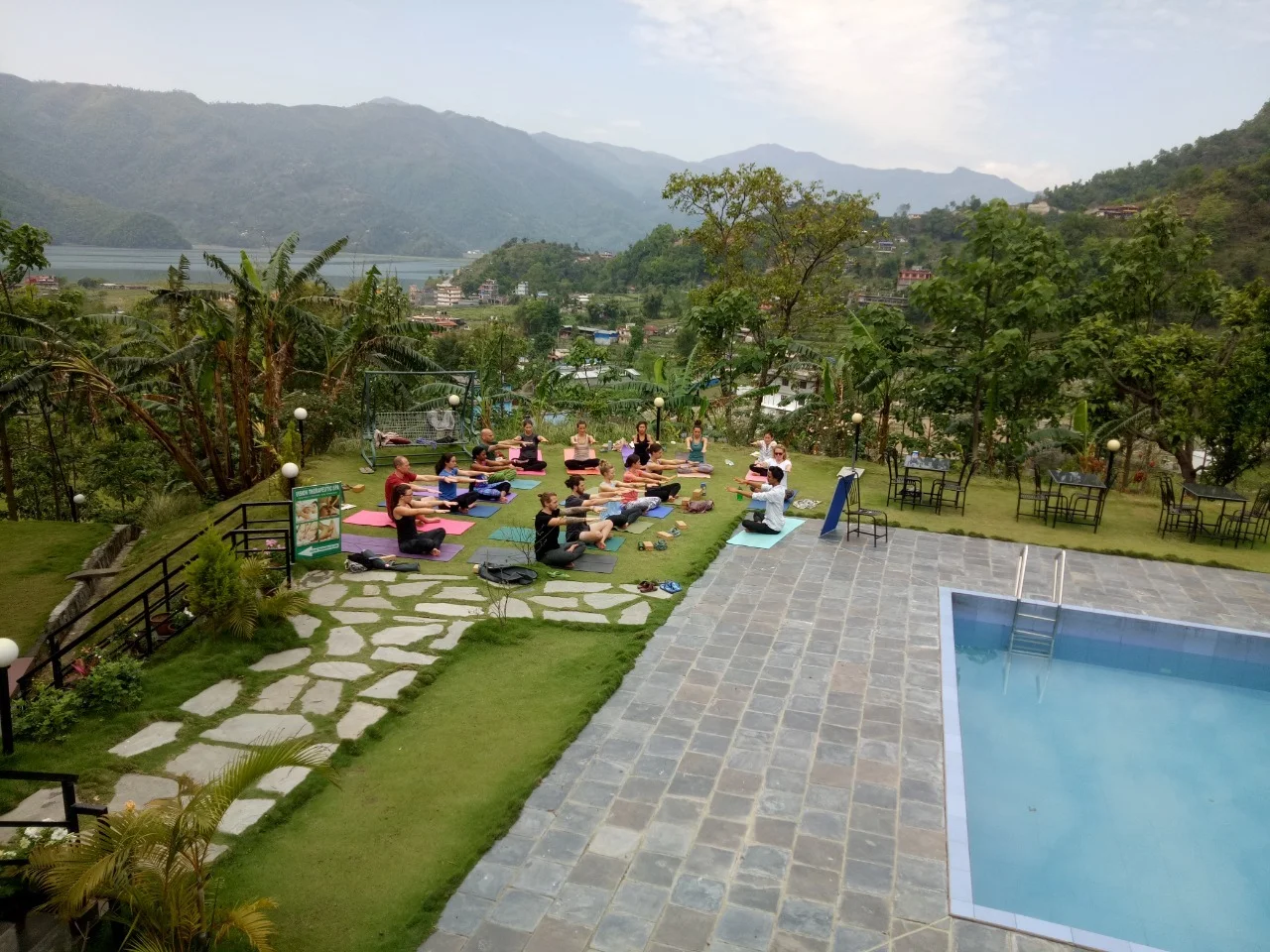
At Pokhara Yoga Academy, we’ve built our entire teaching environment around this observation, with the Annapurna range visible from much of our campus. This article explores why mountain settings genuinely enhance yoga practice — not as marketing flourish, but through a combination of environmental science, yogic tradition, and simple physiological logic — along with what to actually expect and consider if you’re planning to bring your practice to a mountain environment.
Key Takeaways
- Mountain environments support yoga practice through several concrete mechanisms: reduced ambient stress from urban noise and stimulation, cleaner air quality, and psychological effects associated with exposure to vast natural scale.
- Classical yoga texts have long recommended practicing in clean, quiet, natural settings — mountains have held particular significance across Hindu and Buddhist traditions as sites of spiritual practice for millennia.
- Practicing at moderate elevation (below altitudes requiring acclimatization) offers most of the psychological and environmental benefits of mountain settings without the physiological complications of high-altitude practice.
- Mountain settings enhance a yoga practice — they do not replace the fundamentals of consistent practice, proper instruction, and personal effort, which remain the primary determinants of long-term benefit regardless of location.
- Choosing the right mountain destination involves weighing elevation, accessibility, seasonal timing, and the quality of instruction available — the setting alone is not sufficient without a well-structured practice environment.
Why Mountains Have Always Mattered to Yoga
An Ancient Association, Not a Modern Trend
The connection between yoga and mountain environments predates modern wellness tourism by thousands of years. The Himalayas specifically are considered the traditional home of Lord Shiva, regarded in yogic tradition as the first yogi (Adiyogi), and have served as a site of meditation, austerity, and spiritual practice across Hindu and Buddhist traditions for millennia. This isn’t incidental scenery — it’s foundational to how yoga’s broader philosophical tradition understands the relationship between environment and inner practice.
What Classical Texts Say About Practice Environment
Traditional Hatha yoga texts, including the Hatha Yoga Pradipika, specifically recommend practicing in a clean, quiet, naturally pleasant setting, away from excessive noise, crowds, and disturbance. Mountains — quiet, sparsely populated, visually vast — represent something close to an ideal expression of this classical guidance, particularly compared to the noise and stimulation of a typical urban environment.
The Environmental Science Behind Mountain Practice
Air Quality and Respiratory Benefits
Mountain environments, particularly those removed from major urban centers, generally offer meaningfully cleaner air than city environments — directly relevant to a practice built substantially around breath work (pranayama), where air quality has a genuine, measurable effect on practice depth and comfort.
Reduced Ambient Stress and Sensory Load
Urban environments impose a nearly constant low-level sensory load — traffic noise, crowds, artificial lighting, notifications — that mountain settings largely remove. This reduction in ambient stimulation isn’t merely pleasant; it measurably lowers baseline stress-response activation, making it considerably easier to access the parasympathetic, “rest and digest” state that yoga practice specifically aims to cultivate.
Why This Matters More Than It Might Seem
A nervous system that’s already partially activated by background urban stress starts every yoga session from a different baseline than one settled into a quiet mountain environment. This isn’t a minor aesthetic difference — it changes how quickly and how deeply a practitioner can access the calming effects that yoga is specifically designed to produce.
Awe and Psychological Scale
Exposure to landscapes of significant natural scale — mountains, in particular — is associated in environmental psychology research with what’s often termed the “awe effect”: a measurable shift in perspective that tends to reduce self-focused rumination and increase feelings of connection and wellbeing. Combined with yoga’s own attention-training effects, this creates a genuinely reinforcing combination rather than two separate, unrelated benefits.
Natural Light and Circadian Rhythm
Mountain retreat environments typically involve considerably more natural light exposure and outdoor time than urban daily life allows, supporting healthier circadian rhythm regulation — a factor with direct downstream effects on sleep quality, mood stability, and the body’s overall stress resilience.
The Practical Reality: What Mountain Yoga Actually Looks Like
It’s Not Just About the View
While the visual experience of practicing with mountain scenery is genuinely significant, the deeper benefit comes from the combination of factors described above — air quality, reduced sensory load, natural light, and psychological scale — working together, rather than the view functioning as a scenic backdrop alone.
Elevation Matters More Than People Expect
Not all “mountain yoga” experiences are equivalent, and elevation plays a meaningful role in both benefit and risk. Moderate elevations — roughly 800 to 2,000 meters — generally offer the environmental and psychological benefits of a mountain setting without requiring acclimatization or carrying meaningful altitude-related health risk for most practitioners. Higher elevations, by contrast, introduce genuine physiological considerations that need to be taken seriously.
Understanding Altitude and Yoga Practice
At higher altitudes, reduced oxygen availability affects both physical exertion capacity and, in some cases, sleep quality during initial acclimatization — meaning a more vigorous style like Ashtanga or fast-paced Vinyasa may need to be approached more conservatively at significant elevation than it would be at sea level, at least until the body has had time to adjust.
Seasonal Timing Significantly Affects the Experience
Mountain visibility, weather comfort, and overall practice conditions vary considerably by season. Clear skies and comfortable temperatures during spring and autumn months generally offer the most reliable mountain-viewing and outdoor practice conditions, while monsoon season can obscure mountain views entirely for extended periods, even though indoor practice remains fully viable.
Pokhara: A Case Study in Mountain Yoga Done Well
The Annapurna Advantage
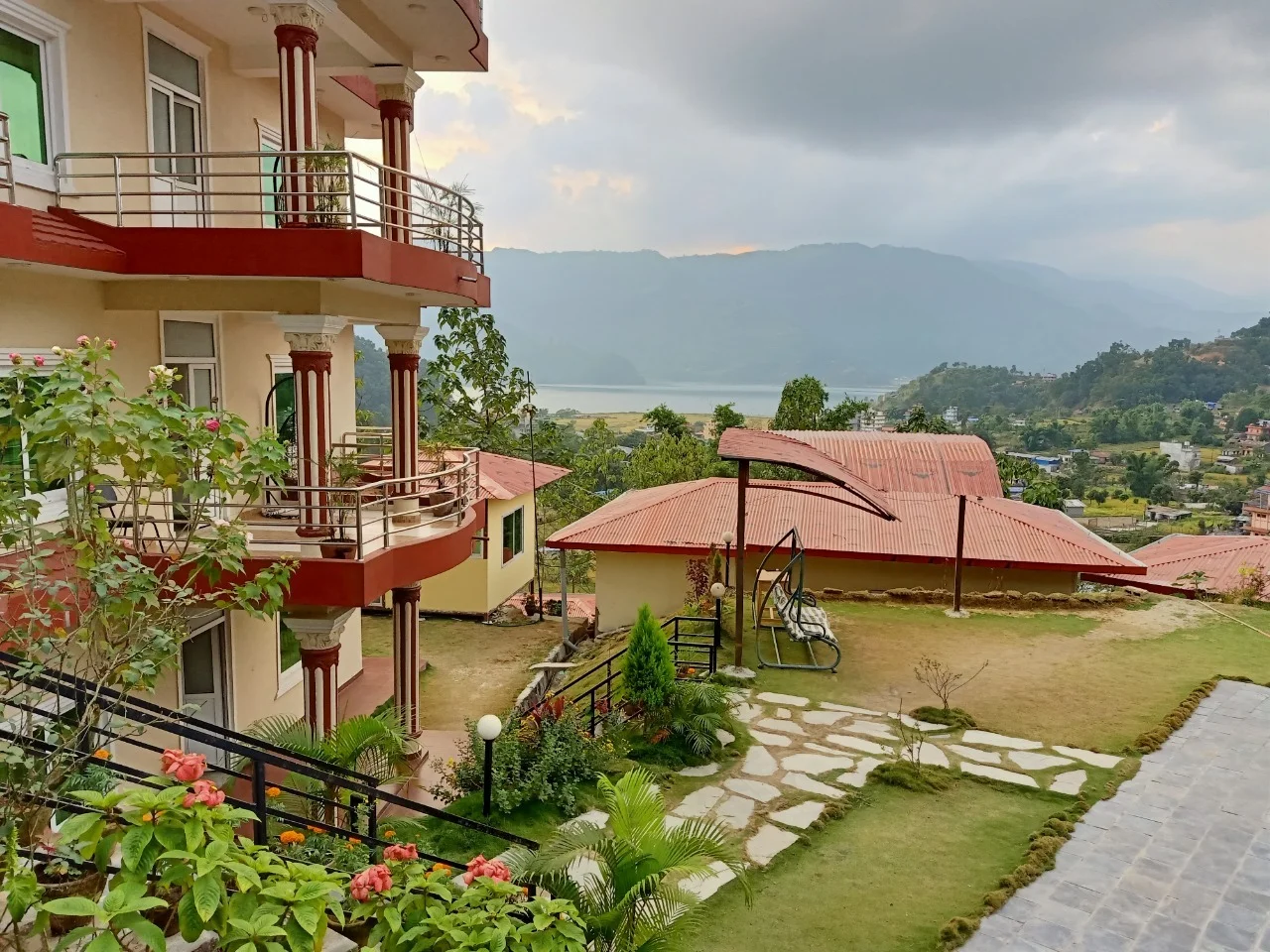
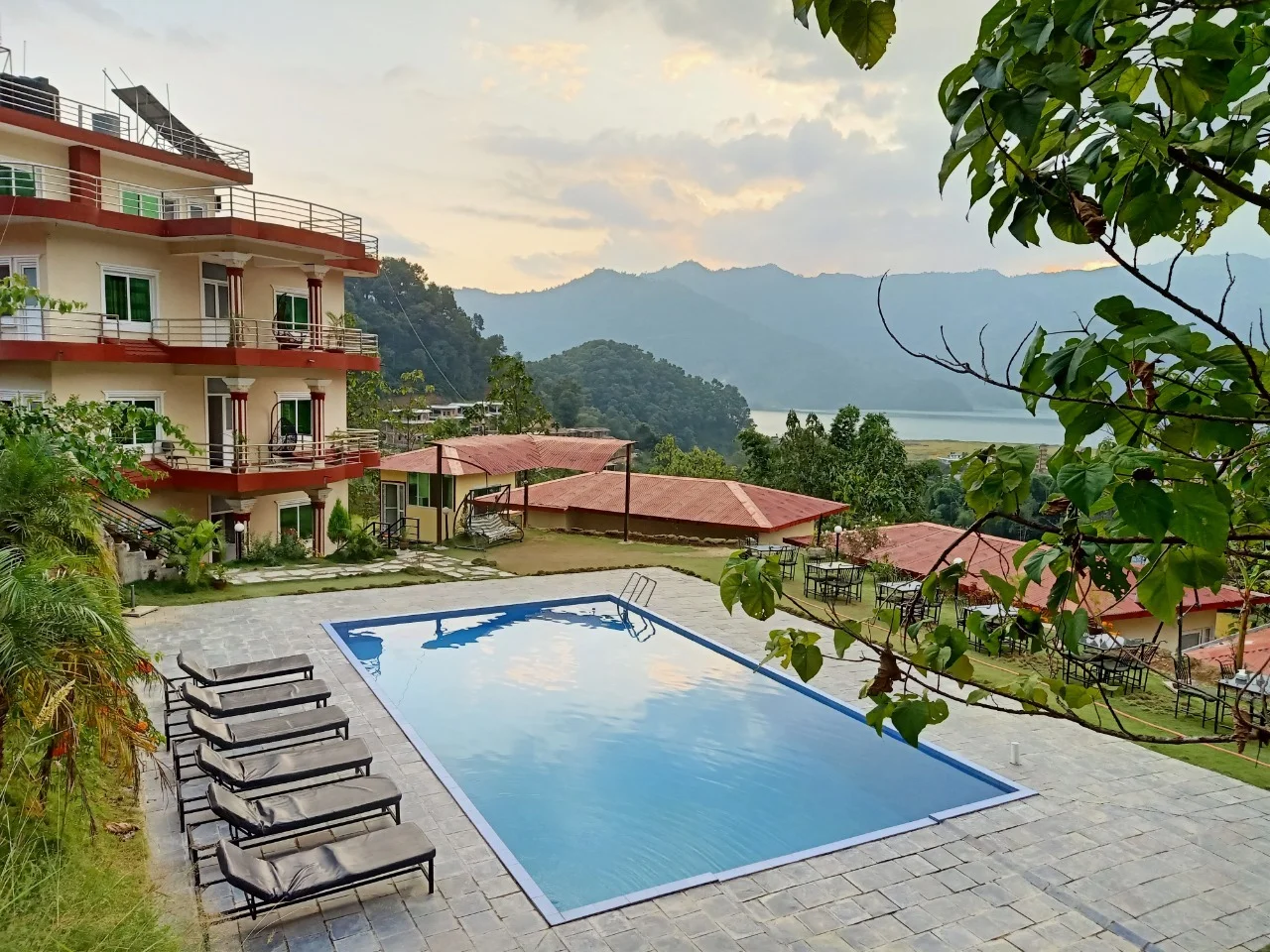
Pokhara offers a particularly compelling combination for mountain-based yoga practice: direct, close-range views of the Annapurna range at a comfortable, non-acclimatization-requiring elevation of roughly 800 meters, combined with the calming presence of Phewa Lake and a well-established international yoga community.
Why Comfortable Elevation Matters for Practice Quality
Because Pokhara sits well below altitudes requiring acclimatization, practitioners can engage in a full range of yoga styles — from vigorous Vinyasa to slow, meditative Yin — without the physiological complications that would apply at genuinely high-altitude locations, while still benefiting from meaningful mountain proximity and visual scale.
A Living Practice Community, Not Just Scenery
Beyond the environmental factors, Pokhara’s established yoga teacher training and retreat infrastructure means visiting practitioners have access to genuinely experienced instruction, not simply a beautiful location without adequate teaching support — an important distinction, since setting alone, without quality guidance, offers a meaningfully incomplete experience.
What Mountain Settings Cannot Replace
Consistency Still Matters Most
However significant the environmental benefits, they remain a complement to — not a substitute for — the fundamental drivers of yoga’s benefits: consistent practice, proper technique, and genuine personal engagement with the process. A single mountain retreat, however powerful the experience, will not produce lasting change without some form of continued practice afterward.
Quality of Instruction Remains Essential
A stunning mountain backdrop paired with inadequate or poorly structured instruction produces a considerably weaker experience than solid instruction in a more ordinary setting. Environment enhances good teaching; it doesn’t substitute for it.
Individual Adaptation Still Required
Even in an objectively excellent environment, individual factors — physical limitations, experience level, personal goals — still determine what a genuinely appropriate and beneficial practice looks like for any given person. No setting, however ideal, removes the need for practice to be thoughtfully adapted to the individual.
Why This Honesty Matters
Framing any single factor — including a stunning natural setting — as sufficient on its own tends to oversimplify a genuinely multifaceted practice, and it can lead newcomers toward disappointment if they expect a mountain trip alone to produce results without any accompanying consistency or quality instruction.
How to Choose a Mountain Yoga Destination Thoughtfully
Questions Worth Asking Before Booking
- What is the actual elevation, and does it require acclimatization?
- What is the quality and experience level of the teaching faculty, independent of the setting itself?
- What does a typical daily schedule look like, and does it balance practice time with rest and integration?
- What time of year offers the most reliable weather and mountain visibility for this specific location?
Red Flags to Watch For
- Marketing that emphasizes scenery almost exclusively, with minimal detail about actual curriculum or teacher qualifications
- No clear information about elevation or altitude-related guidance
- Reviews that focus heavily on the location but rarely mention the quality of instruction
Bringing the Mountain Experience Into a Sustainable Practice
What Actually Transfers Home
The specific environmental conditions of a mountain retreat — the air quality, the visual scale, the natural light — don’t transfer directly into most practitioners’ daily lives back in urban or suburban settings. What does transfer, when deliberately cultivated, is the felt experience of what a settled, unhurried practice feels like, along with any specific techniques or habits learned during the immersion.
Recreating Elements, Not the Whole Experience
Rather than attempting to replicate a mountain retreat’s full environmental conditions at home, most practitioners benefit more from identifying specific, transferable elements — a consistent outdoor practice component, a particular breathing technique, a commitment to a distraction-free practice space — and building those deliberately into an ordinary routine.
Frequently Asked Questions About Yoga in the Mountains
Why is mountain yoga considered beneficial?
Mountain environments generally offer cleaner air, reduced ambient sensory stress, and psychological effects associated with exposure to natural scale, all of which support the physiological and mental state that yoga practice aims to cultivate. These benefits complement, rather than replace, the fundamentals of consistent practice and quality instruction.
Do I need to worry about altitude sickness practicing yoga in the mountains?
At moderate elevations — generally below 2,000 to 2,500 meters — most practitioners face minimal altitude-related risk. Higher elevations require genuine acclimatization consideration, and vigorous yoga styles should generally be approached more conservatively until the body has adjusted.
Is Pokhara a good location for mountain yoga practice?
Yes. Pokhara sits at a comfortable elevation of roughly 800 meters, offering direct Annapurna mountain views without requiring altitude acclimatization, combined with an established yoga teaching community and infrastructure suited to a full range of practice styles.
Can mountain scenery alone improve my yoga practice?
Scenery contributes meaningfully to the overall experience, but genuine, lasting benefit still depends primarily on consistent practice, proper technique, and quality instruction. A beautiful setting enhances a well-structured practice; it doesn’t substitute for one.
What time of year is best for mountain yoga retreats?
Spring (March–May) and autumn (September–November) generally offer the clearest mountain visibility and most comfortable weather conditions for outdoor practice, while monsoon season can obscure mountain views, though indoor practice remains fully viable.
How do I choose between different mountain yoga retreat destinations?
Consider elevation and acclimatization requirements, the experience and credentials of the teaching faculty independent of the scenery, the balance of the daily schedule between practice and rest, and seasonal timing for reliable weather and visibility at your chosen destination.
The Honest Conclusion: A Powerful Complement, Not a Complete Answer
Mountain environments genuinely enhance yoga practice — through cleaner air, reduced sensory stress, meaningful psychological effects, and a living philosophical tradition that has recognized this connection for millennia. That’s a real, well-supported claim worth taking seriously. What isn’t accurate is the idea that setting alone is sufficient — that simply being in the mountains replaces the ordinary, unglamorous work of consistent practice, proper instruction, and personal effort that actually produces lasting benefit.
At Pokhara Yoga Academy, we built our programs around the Annapurna range specifically because we believe environment matters — genuinely, measurably matters — while never mistaking it for a substitute for rigorous teaching and sustained practice. The mountains offer something rare and valuable. What you build with that environment, through consistent effort, is what ultimately determines whether the experience becomes a memorable trip or a lasting transformation.

Comments are closed