When Is Vinyasa Yoga the Right Choice for You? A Complete, Honest Guide
By the Faculty at Pokhara Yoga Academy
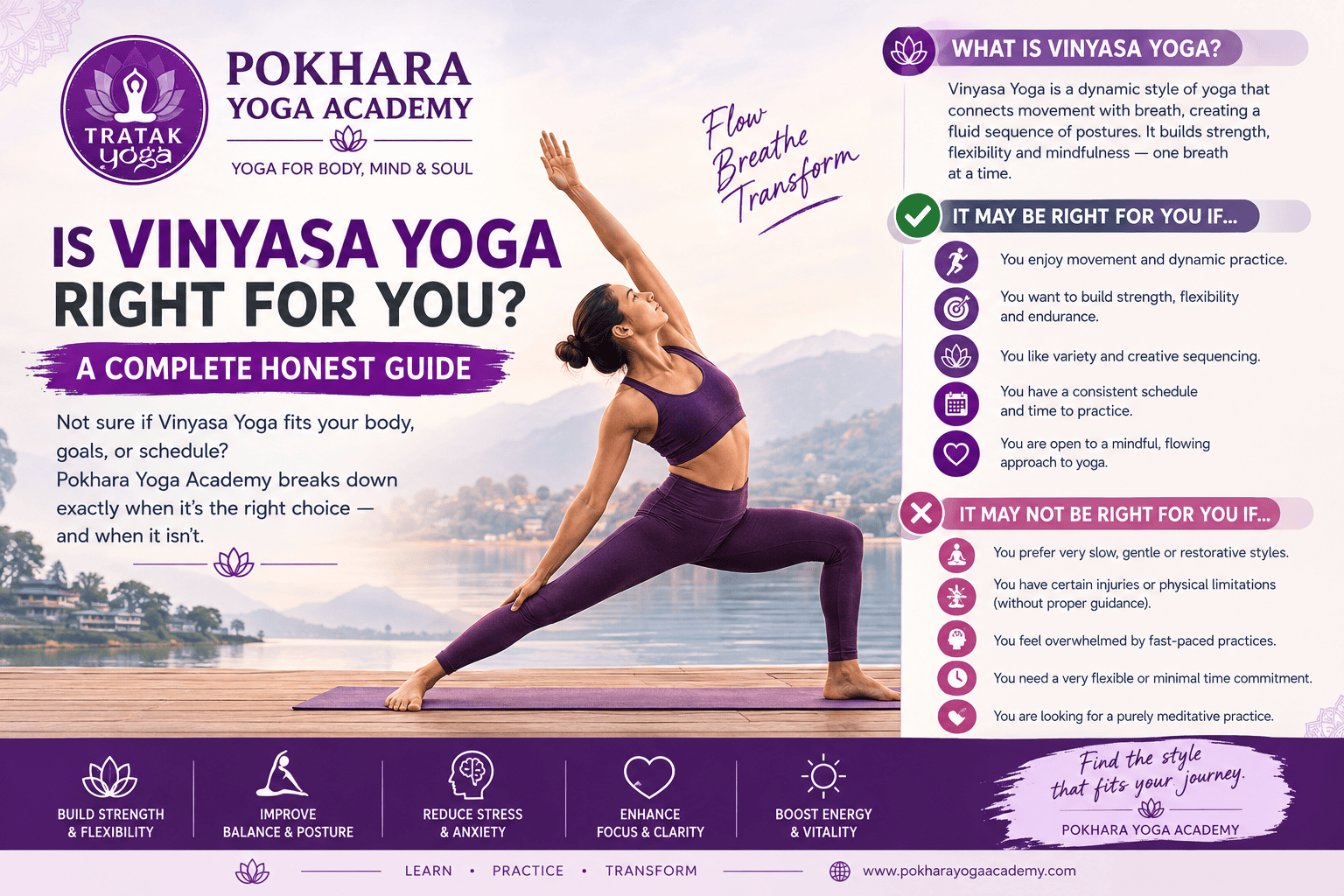
Walk into almost any yoga studio today and “Vinyasa” is probably the most common class on the schedule. It’s popular, it’s dynamic, and it photographs beautifully for social media — but popularity isn’t the same as fit. Vinyasa Yoga is genuinely excellent for some bodies, goals, and temperaments, and genuinely not the best starting point for others.
As a teacher training school that certifies instructors across multiple yoga styles — Hatha, Ashtanga, and Vinyasa among them — we get this question constantly from prospective students: “Which style should I actually start with?” This guide answers that question specifically for Vinyasa Yoga, honestly, without the marketing gloss that usually surrounds it. By the end, you’ll know not just what Vinyasa is, but whether it genuinely fits where you are right now.
Key Takeaways
- Vinyasa Yoga is a breath-synchronized, continuously flowing style where poses are linked together in a sequence rather than held statically — the word itself roughly translates to “arranging something in a special way.”
- It’s an excellent fit for people who want a cardiovascular, creative, and varied practice, enjoy movement-based mindfulness, and have no major joint or cardiac restrictions.
- It’s generally not the ideal starting point for complete beginners with zero yoga background, those recovering from injury, pregnant practitioners past the first trimester, or people seeking a slow, deeply meditative practice.
- Vinyasa classes vary enormously between teachers and studios — the same class name can mean a gentle flow or an intense, athletic workout, so trying a few different teachers before judging the style is essential.
- Most experienced practitioners eventually blend styles — using Hatha or Yin for alignment and restoration, and Vinyasa for cardiovascular and creative expression — rather than committing to just one for life.
What Is Vinyasa Yoga, Exactly?
The Literal and Practical Meaning
“Vinyasa” comes from the Sanskrit nyasa (to place) combined with the prefix vi (in a special way) — essentially, “to place in a specific sequence.” In practice, this means postures are linked together through continuous movement, with each transition tied to either an inhale or an exhale. This breath-movement pairing is the defining technical feature of Vinyasa — without it, a sequence is just stretching with pose names attached.
Where Vinyasa Comes From
Vinyasa-style practice draws its structural roots from Ashtanga Yoga, developed by Sri K. Pattabhi Jois in Mysore, India, in the 20th century. As Ashtanga’s popularity spread internationally, teachers began adapting its breath-linked, flowing structure into more varied, less rigidly fixed sequences — creating what is now broadly called Vinyasa or “Vinyasa Flow” Yoga. Unlike Ashtanga, which follows the same fixed sequence every practice, Vinyasa gives teachers creative freedom to design a different flow each class.
What Makes a Class “Vinyasa” vs. Something Else
Feature | Vinyasa Yoga | Hatha Yoga | Ashtanga Yoga |
|---|---|---|---|
Sequence | Varies by teacher/class | Varies, slower-paced | Fixed, unchanging |
Pace | Continuous, flowing | Slow, longer holds | Continuous, vigorous |
Breath-movement link | Central to every transition | Present but less continuous | Central to every transition |
Best for | Cardio + creativity seekers | Beginners, alignment focus | Discipline-oriented practitioners |
The Real Benefits of Vinyasa Yoga
Cardiovascular Conditioning
Because Vinyasa keeps the body in near-constant motion, it functions as a legitimate form of aerobic exercise, elevating heart rate more consistently than static-hold yoga styles. For practitioners looking for a workout that also incorporates mindfulness and flexibility work, this dual benefit is a major draw.
Full-Body Strength Development
Common Vinyasa transitions — Chaturanga Dandasana (low plank), Downward-Facing Dog, Warrior sequences — repeatedly engage the shoulders, core, and legs. Practiced consistently, this builds functional strength that’s noticeably different from isolated weight-training, since it emphasizes control through movement rather than static load-bearing.
Mental Focus Through Movement
Because each breath is tied to a specific movement, Vinyasa demands continuous attention — there’s little room for the mind to wander when the next transition is always one breath away. Many practitioners describe this as a more accessible entry point into mindfulness than seated meditation, since the physical engagement gives the mind something concrete to anchor to.
Why Some People Find Flow Easier to Focus In Than Stillness
Seated meditation asks the mind to settle without an external task to hold attention. Vinyasa provides that external task — the next breath, the next movement — which is precisely why many naturally restless or high-energy people find a moving practice easier to sustain focus in than a still one.
Creative Variety That Prevents Practice Boredom
Because sequences change from class to class and teacher to teacher, Vinyasa rarely feels repetitive in the way a fixed-sequence practice can over months or years. For practitioners who thrive on novelty, this variety is a genuine long-term adherence advantage — the style you’ll actually keep practicing tends to be the one that doesn’t bore you.
When Vinyasa Yoga Is the Right Choice for You
You Want a Workout and a Mindfulness Practice in One
If your primary goal is combining physical exertion with breath-based mindfulness — rather than choosing between “gym” and “meditation” — Vinyasa is specifically designed to deliver both simultaneously.
You Enjoy Variety and Get Bored by Repetition
If the idea of practicing the exact same sequence every session (as in Ashtanga) sounds tedious rather than meditative, Vinyasa’s built-in variety will likely keep you more engaged long-term.
You Have a Reasonable Baseline of Physical Fitness
Vinyasa’s continuous pace assumes a baseline level of cardiovascular and muscular readiness. If you can comfortably walk briskly for 20–30 minutes or have some existing exercise habit, you’ll likely adapt to Vinyasa’s pace without excessive strain.
You’re Drawn to the Athletic, Dynamic Side of Yoga
Some practitioners are simply drawn more to yoga’s physical, athletic expression than its slower, contemplative side — and there’s nothing wrong with that. Vinyasa honors this preference without abandoning yoga’s mindfulness foundations.
You Want a Practice That Complements Other Athletic Training
Runners, cyclists, and strength athletes often find Vinyasa an excellent complementary practice — it builds mobility and body awareness in a format that feels more aligned with an athletic mindset than slower, more meditative styles.
When Vinyasa Yoga Might NOT Be the Right First Choice
You’re a Complete Beginner With No Movement Background
Vinyasa’s continuous pace doesn’t leave much room to pause and correct alignment mid-flow. Complete beginners often benefit more from starting in a Hatha class, where slower pacing allows time to actually learn what correct alignment feels like in each posture — foundational knowledge that makes a later transition into Vinyasa both safer and more effective.
You Have a Joint Injury, Chronic Pain Condition, or Recent Surgery
The repeated weight-bearing transitions in Vinyasa (particularly through the wrists, shoulders, and knees) can aggravate certain injuries if attempted before adequate healing and strength have been rebuilt. A gentler, alignment-focused style — or direct guidance from a physical therapist alongside a yoga teacher — is usually the safer starting point.
You Are Pregnant, Especially Past the First Trimester
Standard Vinyasa sequencing includes deep twists, core-intensive transitions, and rapid pacing that generally isn’t appropriate for pregnancy past the first trimester. A dedicated prenatal yoga class — which modifies sequencing specifically for pregnancy — is the safer and more appropriate choice.
You Have Uncontrolled High Blood Pressure or Cardiac Conditions
Because Vinyasa elevates heart rate significantly and includes rapid position changes (which can affect blood pressure regulation), practitioners with cardiac conditions should consult a physician and consider a gentler style, or a specifically adapted, slower-paced Vinyasa practice under close teacher supervision.
You’re Seeking a Primarily Meditative, Restorative Experience
If what you actually want is stillness, long holds, and deep physical release — the goals typically associated with Yin Yoga or Restorative Yoga — Vinyasa’s continuous, energizing pace works against that intention rather than supporting it.
A Practical Litmus Test
Ask yourself honestly: after a stressful day, do you crave movement to burn off the tension, or stillness to settle into it? Vinyasa suits the former; a slower style suits the latter. Neither answer is wrong — they simply point toward different practices.
How to Try Vinyasa Yoga Without Overcommitting
1. Attend a “Gentle” or “Slow Flow” Vinyasa Class First
Many studios offer graded intensity levels within the Vinyasa category itself. A “gentle flow” or “slow flow” class retains the breath-linked structure while moderating pace and intensity — an excellent low-risk way to test whether the style suits you.
2. Try Several Different Teachers Before Judging the Style
Because Vinyasa sequences are teacher-designed rather than fixed, the exact same class name can feel completely different depending on who’s teaching it. Don’t rule out the entire style based on one class with one teacher — try at least three different instructors before forming a final opinion.
3. Communicate Injuries and Limitations Before Class Starts
A competent Vinyasa teacher can modify transitions on the spot for known limitations — but only if they know about them beforehand. Arrive early and mention any relevant physical history directly.
4. Pay Attention to How Your Body Feels 24 Hours Later, Not Just Immediately After
Vinyasa’s endorphin-driven “feel-good” effect immediately post-class can mask overexertion that shows up as soreness or joint irritation the following day. Track how you feel a full day later before deciding whether the intensity level was appropriate for you.
Vinyasa Yoga and Teacher Training: A Natural Next Step
For practitioners who fall in love with Vinyasa’s creative, flowing structure, a natural progression is often Vinyasa or Vinyasa-influenced Yoga Teacher Training — not necessarily to teach professionally, but to deepen understanding of sequencing logic, breath mechanics, and the anatomical reasoning behind transitions that a regular class schedule doesn’t have time to fully explain.
A well-structured Vinyasa-focused teacher training program typically layers in:
- Sequencing principles — how to build a class arc that makes anatomical and energetic sense
- Breath cueing — teaching students to actually link movement and breath, not just move quickly
- Anatomy specific to common Vinyasa transitions (shoulder mechanics in Chaturanga, hip mechanics in Warrior sequences)
- Modifications for injury, pregnancy, and varying fitness levels within a flowing class format
Frequently Asked Questions About Vinyasa Yoga
1. Is Vinyasa Yoga good for beginners?
Vinyasa can work for beginners with some baseline fitness, but complete beginners with no movement background often benefit more from starting in a slower-paced Hatha class first to learn foundational alignment before adding Vinyasa’s continuous pace.
2. What is the difference between Vinyasa and Hatha Yoga?
Vinyasa links postures together in continuous, breath-synchronized movement with sequences that vary by teacher, while Hatha Yoga uses slower pacing and longer pose holds, allowing more time to focus on alignment in each individual posture.
3. Can Vinyasa Yoga help with weight loss?
Vinyasa’s continuous movement and elevated heart rate can support calorie expenditure and cardiovascular fitness as part of an overall weight management approach, though results depend significantly on class intensity, frequency, and accompanying nutrition habits.
4. Is Vinyasa Yoga safe during pregnancy?
Standard Vinyasa classes are generally not recommended past the first trimester due to deep twists, core-intensive poses, and fast pacing. A dedicated prenatal yoga class, specifically modified for pregnancy, is the safer choice.
5. How is Vinyasa Yoga different from Ashtanga Yoga?
Ashtanga follows a fixed, unchanging sequence practiced the same way every session, typically in Mysore style, while Vinyasa allows teachers to design varied sequences for each class, offering more creative variety but less structural consistency between sessions.
6. How many times a week should I practice Vinyasa Yoga?
For general fitness and mindfulness benefits, 2–4 sessions per week is a commonly recommended starting frequency, allowing adequate recovery time between sessions while still building consistency in strength, flexibility, and breath awareness.
Making the Right Choice for Your Practice
There’s no universally “best” yoga style — only the style that’s best for your body, your goals, and your current season of life. Vinyasa Yoga earns its popularity honestly: it’s dynamic, creative, and genuinely effective for cardiovascular fitness and moving mindfulness. But honest guidance also means being clear about who it doesn’t suit as a starting point — complete beginners, certain injuries, pregnancy past the first trimester, and those seeking a primarily restorative experience.
At Pokhara Yoga Academy, we teach across multiple styles specifically because we believe good teaching starts with matching the practice to the person — not the other way around. Whether Vinyasa turns out to be your long-term practice or simply one useful tool among several, understanding honestly where it fits is the first step toward a sustainable relationship with yoga.
Comments are closed