Yin Yoga: A Complete Guide to Its Practice and Benefits
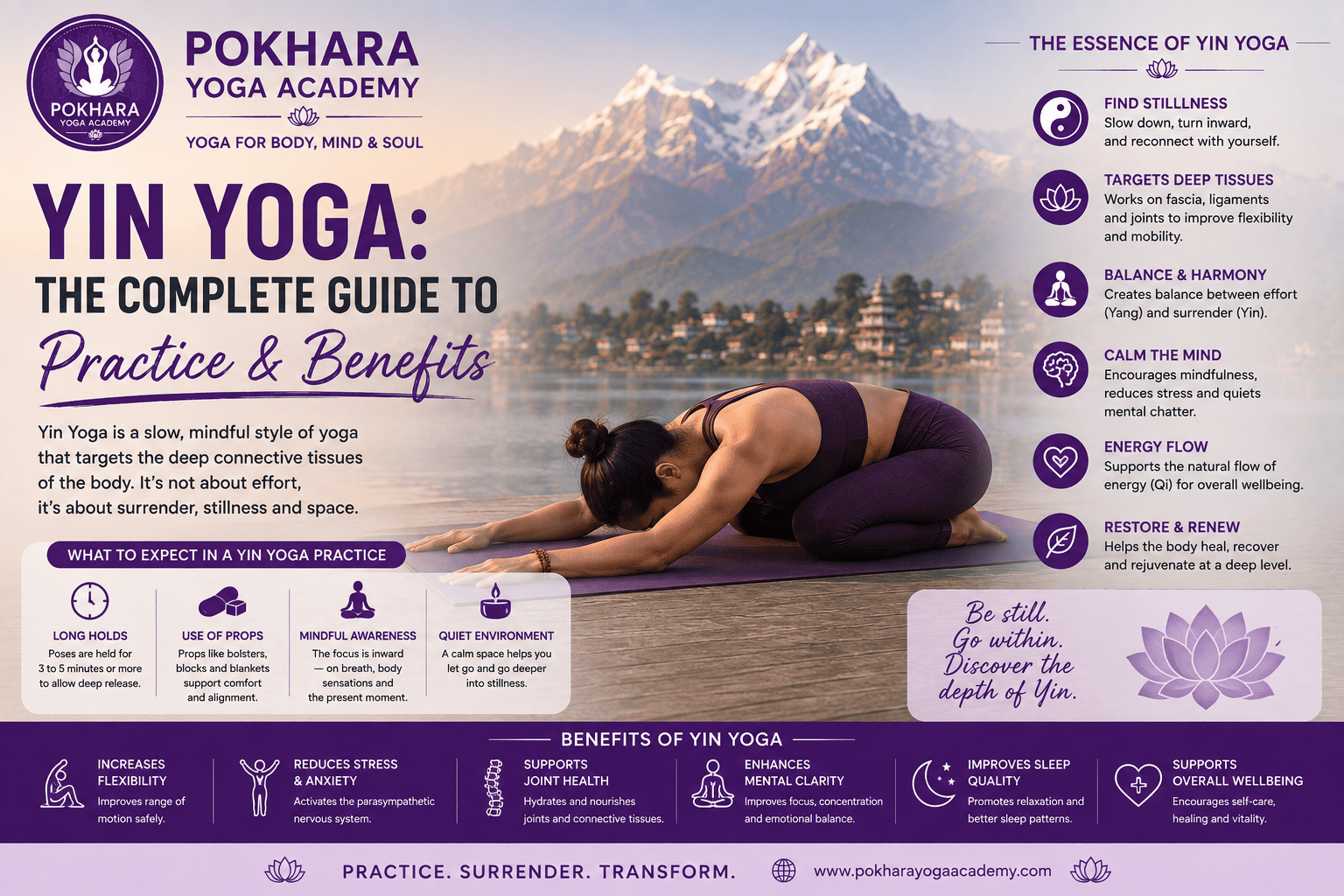
In a wellness culture that often equates value with intensity — more sweat, more reps, more burn — Yin Yoga asks you to do almost nothing at all. Poses are held for three to five minutes, sometimes longer, with muscles fully relaxed and no active effort required. To someone used to a Vinyasa flow or an Ashtanga sequence, it can look, frankly, unimpressive. It is anything but.
At Pokhara Yoga Academy, we teach Yin Yoga as a deliberate counterbalance to the more dynamic styles that dominate most students’ practice, because the body’s connective tissue — the target of Yin practice — simply doesn’t respond to the same stimulus that muscles do. This guide explains what Yin Yoga actually is, the science and philosophy behind why it works, what a class looks like, and how to know whether it belongs in your practice.
Key Takeaways
- Yin Yoga is a slow-paced style involving passive, long-held poses (typically 2–5 minutes or longer) that target connective tissue — fascia, ligaments, and joints — rather than muscles, which are the primary focus of most other yoga styles.
- The practice is rooted in Taoist philosophy and traditional Chinese medicine concepts of yin and yang, meridian lines, and energetic balance, alongside its more recent Western anatomical framing developed by teachers like Paul Grilley and Sarah Powers.
- Yin Yoga’s core benefits include improved joint mobility, enhanced flexibility at a connective-tissue level, nervous system regulation, and a meditative mental training that complements more dynamic (“yang”) practices.
- Yin Yoga is distinct from Restorative Yoga — Yin intentionally applies mild stress to connective tissue for adaptation, while Restorative Yoga is entirely passive, prop-supported, and aimed purely at relaxation.
- Because it targets connective tissue rather than muscle, safe Yin practice requires understanding specific contraindications — including certain joint conditions, hypermobility, and pregnancy — that differ from precautions in more dynamic yoga styles.
What Is Yin Yoga? Understanding the Method
The Origins: Taoist Philosophy Meets Modern Anatomy
Yin Yoga’s foundations trace to Taoist yoga practices, later brought into a Western yoga context in the 1970s by martial artist and yoga teacher Paulie Zink, and subsequently developed into the more widely taught modern form by his students Paul Grilley and Sarah Powers. Grilley, in particular, incorporated detailed anatomical study — especially research into individual skeletal variation — into how Yin poses are taught and adapted, giving the practice a distinctly evidence-informed approach alongside its philosophical roots.
Yin and Yang: The Core Philosophical Framework
Drawing from Taoist philosophy, “yin” and “yang” represent complementary opposites — passive and active, still and dynamic, cool and warm. Most yoga styles practiced today, including Vinyasa and Ashtanga, are considered “yang” in this framework: active, muscle-engaging, and heat-generating. Yin Yoga deliberately occupies the opposite end of that spectrum — passive, connective-tissue-focused, and cooling — offering a genuine counterbalance rather than simply a “gentler” version of the same thing.
What Makes a Pose “Yin”
A pose becomes a Yin practice through three defining principles, often summarized as the practice’s core framework:
- Find an appropriate edge — a position with mild, sustainable sensation, well short of pain
- Remain still — muscles relaxed, minimal movement once settled into the pose
- Hold for time — typically 2–5 minutes, sometimes longer, allowing connective tissue enough sustained stress to adapt
The Science Behind Yin Yoga: Why Long Holds Work Differently
Muscles vs. Connective Tissue
Muscles are elastic and respond well to relatively brief, repeated stretching — the kind found in most dynamic yoga styles and general stretching routines. Connective tissue — fascia, tendons, and ligaments — is denser, less elastic, and responds to an entirely different stimulus: sustained, gentle stress over several minutes, not brief repeated movement.
Why Short Stretches Don’t Reach Connective Tissue
A 15–30 second stretch, typical in most warm-up or cooldown routines, primarily affects muscle tissue and has minimal lasting effect on the denser connective tissue surrounding joints. This is precisely why Yin Yoga’s distinctively long hold times exist — they’re not an arbitrary stylistic choice, but a deliberate response to how connective tissue physiologically adapts.
The Role of the Nervous System
Beyond its connective-tissue effects, sustained stillness in Yin poses — combined with the absence of active muscular effort — encourages a shift toward parasympathetic nervous system activation, similar to meditation. This is a major reason Yin Yoga is frequently described as feeling meditative even before any formal meditation instruction is introduced.
Meridian Lines and Traditional Chinese Medicine
Traditional Yin Yoga teaching also incorporates the concept of meridians — energy pathways described in traditional Chinese medicine — with specific poses believed to stimulate particular meridian lines and their associated organ systems. While this framework is rooted in a different explanatory tradition than Western anatomical science, many practitioners find it a valuable complementary lens for understanding the practice’s broader energetic intention, alongside its more measurable physical effects.
Common Yin Yoga Poses and What They Target
Butterfly Pose (Seated)
A forward fold with the soles of the feet together, targeting the inner thighs, hips, and lower back — one of the most commonly used entry poses in a Yin sequence due to its accessibility across most body types.
Dragon Pose
A deep, low lunge variation held for an extended time, targeting the hip flexors and quadriceps — often considered one of the more physically intense Yin poses due to the depth of stretch involved.
Sleeping Swan
A seated hip-opener with one leg folded forward and the other extended back, targeting the outer hip and glute area — commonly used to address tightness accumulated from prolonged sitting.
Caterpillar Pose
A seated forward fold over extended legs, targeting the entire posterior chain — hamstrings, lower back, and spine — typically held longer than most other poses in a sequence due to its broad-reaching effect.
Saddle Pose
A reclined backbend with the legs folded beneath the body, targeting the quadriceps and front of the hips — generally considered a more advanced pose requiring adequate knee flexibility, often modified with props for most practitioners.
A Note on Modifications
Because Yin poses are held for extended periods, appropriate modification matters considerably more here than in faster-paced styles, where a brief moment of imperfect alignment carries less risk. Props — blocks, bolsters, blankets — are commonly and appropriately used throughout Yin practice to bring poses within a safe, sustainable range for each individual body.
The Core Benefits of Yin Yoga
Improved Joint Mobility and Range of Motion
By specifically targeting connective tissue around joints — rather than just the surrounding muscles — Yin Yoga supports genuine improvements in range of motion that complement, rather than duplicate, the flexibility gains from more dynamic styles.
Enhanced Recovery for Athletes and Dynamic Yoga Practitioners
Because Yin specifically addresses connective tissue and joint mobility rather than muscular strength, it’s commonly used as a complementary recovery practice by athletes and practitioners of more vigorous yoga styles, addressing exactly what faster-paced training typically doesn’t have time to target.
Nervous System Regulation and Stress Reduction
The combination of stillness, extended holds, and minimal muscular engagement makes Yin Yoga one of the more reliably calming styles available, with many practitioners reporting stress-reduction effects comparable to seated meditation.
A More Accessible Entry Point Into Meditation
For practitioners who find seated meditation difficult to sustain, Yin Yoga’s physical stillness combined with a specific point of focus (breath, sensation, or a chosen meridian) often serves as a more approachable bridge into meditative practice than jumping directly into unsupported stillness.
Improved Body Awareness
The extended hold times in Yin practice create considerably more opportunity to notice subtle sensation, tension patterns, and habitual bracing than faster-paced styles allow — a form of body awareness training that often carries over meaningfully into daily posture and movement habits.
Yin Yoga vs. Restorative Yoga: A Common Point of Confusion
Because both styles involve slow pacing and stillness, Yin and Restorative Yoga are frequently — and incorrectly — used interchangeably. They are meaningfully different practices.
Factor | Yin Yoga | Restorative Yoga |
|---|---|---|
Goal | Mild stress on connective tissue for adaptation | Complete relaxation, no stress applied |
Prop usage | Minimal to moderate | Extensive, full-body support |
Sensation | Mild stretch/edge sensation | No stretch sensation; fully supported |
Typical hold time | 2–5 minutes | 5–20 minutes |
Best for | Improving joint mobility, meditative focus | Deep relaxation, nervous system recovery |
Which Should You Choose?
If your goal is genuine flexibility and joint mobility improvement alongside a meditative mental focus, Yin Yoga is the more appropriate choice. If your goal is pure, unstructured relaxation with no physical stretching intention at all, Restorative Yoga better matches that specific goal.
Who Should Practice Yin Yoga (And Who Should Modify Carefully)
Ideal Candidates
- Practitioners of dynamic yoga styles or other athletic training seeking a complementary recovery practice
- Those experiencing chronic stress or difficulty with seated meditation, seeking a more accessible entry point into stillness
- Practitioners with generally tight, restricted connective tissue seeking genuine long-term mobility improvement
- Anyone seeking a slower-paced practice that still delivers a meaningful physical training effect, rather than pure passive relaxation
Who Should Approach Yin Yoga With Extra Caution
- Hypermobile individuals — those with naturally very flexible joints should be especially cautious, since Yin’s sustained stress on connective tissue can push already-loose joints beyond a safe range without careful, conservative practice
- Pregnant practitioners — hormonal changes during pregnancy already increase joint laxity, meaning standard Yin depth and hold times generally need significant modification; a dedicated prenatal-adapted practice is recommended
- Those with certain joint conditions — conditions like osteoarthritis in specific joints may require avoiding or significantly modifying poses that place direct sustained stress on the affected area
- Recent injury or surgery — connective tissue healing timelines vary considerably, so clearance from a healthcare provider before resuming Yin practice around an affected area is recommended
Why “Finding Your Edge” Requires Genuine Self-Awareness
Unlike more dynamic styles where discomfort typically signals an immediate need to back off, Yin’s extended hold times mean sensation can shift meaningfully over the course of several minutes. Learning to distinguish a sustainable “edge” sensation from genuine overstretching is a skill that develops with practice — which is precisely why guidance from an experienced teacher matters considerably in the early stages of a Yin practice.
What to Expect in a Typical Yin Yoga Class
- Settling and centering (5–10 minutes) — often seated, with breath awareness
- First pose sequence (20–30 minutes) — typically 4–6 poses, each held 3–5 minutes, often targeting a specific body region (hips, spine, or lower body as a themed focus)
- Brief counter-poses or gentle movement between held poses, allowing the body to reset
- Final relaxation, Savasana (10–15 minutes) — often extended compared to more dynamic styles, given the class’s already meditative pace
The Role of Silence and Minimal Instruction
Unlike more actively cued styles, Yin classes often include extended periods of silence once a pose is established, allowing practitioners to settle into their own internal experience rather than continuously following verbal instruction — a deliberate pedagogical choice that supports the practice’s meditative intention.
Building Yin Yoga Into a Balanced Overall Practice
Complementing “Yang” Practices
Many experienced practitioners deliberately balance more dynamic (“yang”) practices like Vinyasa or Ashtanga with regular Yin sessions, addressing the connective tissue and nervous-system-regulation needs that faster-paced practice alone doesn’t fully cover.
A Reasonable Starting Frequency
For practitioners new to Yin, 1–2 sessions per week alongside other activity is a commonly recommended starting point, allowing the body adequate time to adapt to the specific demands of extended, passive holds.
Yin Yoga Teacher Training
For practitioners drawn specifically to Yin’s meditative, anatomically detailed approach, a dedicated Yin Yoga Teacher Training program offers deeper study into connective tissue anatomy, meridian theory, and the specific sequencing and pacing skills required to teach long-hold practice safely and effectively — distinct in focus from a general Hatha or Vinyasa-oriented training.
Frequently Asked Questions About Yin Yoga
1. What is the difference between Yin Yoga and Restorative Yoga?
Yin Yoga intentionally applies mild, sustained stress to connective tissue to improve joint mobility, using minimal props for moderate support. Restorative Yoga is entirely passive, using extensive props for full-body support, with the goal of complete relaxation rather than any stretching effect.
2. How long should you hold a Yin Yoga pose?
Yin Yoga poses are typically held for 2–5 minutes, sometimes longer for more experienced practitioners, allowing sufficient time for connective tissue to respond to sustained, gentle stress in a way that shorter stretches cannot achieve.
3. Is Yin Yoga good for beginners?
Yes, Yin Yoga is generally accessible to beginners due to its slow pace and passive nature, though beginners should learn proper “edge-finding” technique from an experienced teacher to avoid overstretching during the extended hold times.
4. Can Yin Yoga help with flexibility?
Yes, Yin Yoga specifically targets connective tissue around joints, supporting genuine improvements in range of motion and flexibility that complement, rather than duplicate, the muscular flexibility gains from more dynamic yoga styles.
5. Is Yin Yoga safe during pregnancy?
Standard Yin Yoga generally requires significant modification during pregnancy, since pregnancy hormones already increase joint laxity, and Yin’s sustained connective tissue stress could push already-loose joints beyond a safe range. A dedicated prenatal-adapted practice is recommended.
6. How often should I practice Yin Yoga?
For most practitioners, 1–2 Yin Yoga sessions per week, alongside other physical activity, is a commonly recommended starting frequency, allowing the body adequate time to adapt to the specific demands of extended, passive holds.
Why Yin Yoga Deserves a Place in Every Practice
Yin Yoga’s stillness can look, to the uninitiated, like the least demanding style available. In practice, it asks something genuinely difficult — sustained patience, honest self-awareness about sensation, and a willingness to work with tissue that changes slowly, on its own timeline, regardless of effort. For a wellness culture obsessed with visible intensity, that’s a genuinely countercultural offering.
At Pokhara Yoga Academy, we teach Yin Yoga not as a lesser or “easier” alternative to more dynamic styles, but as a distinct, equally rigorous discipline addressing exactly what those faster practices leave unaddressed. Whether you come to it as a complement to an already active practice or as a standalone path toward greater stillness, Yin Yoga offers a depth that, once experienced, is difficult to categorize as anything less than essential.
Comments are closed