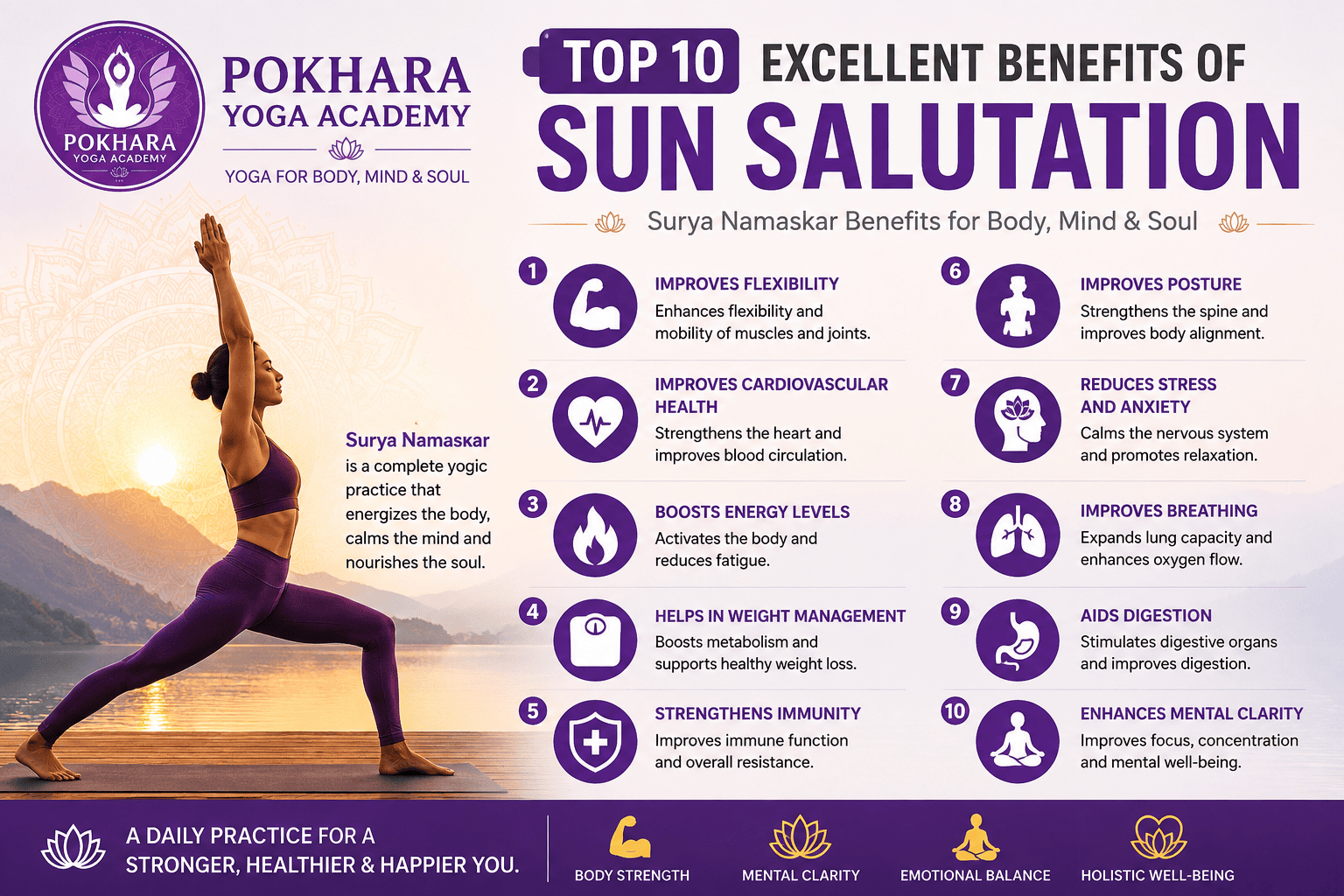
Top 10 Excellent Benefits of Sun Salutation (Surya Namaskar) — A Complete Guide
By the Faculty at Pokhara Yoga Academy
If you could learn only one yoga sequence in your entire life, it should be the sun salutation. Known in Sanskrit as Surya Namaskar, this 12-step flowing sequence is one of the oldest and most complete practices in the yogic tradition — a moving meditation that greets the sun while working every major muscle group, joint, and organ system in the body.
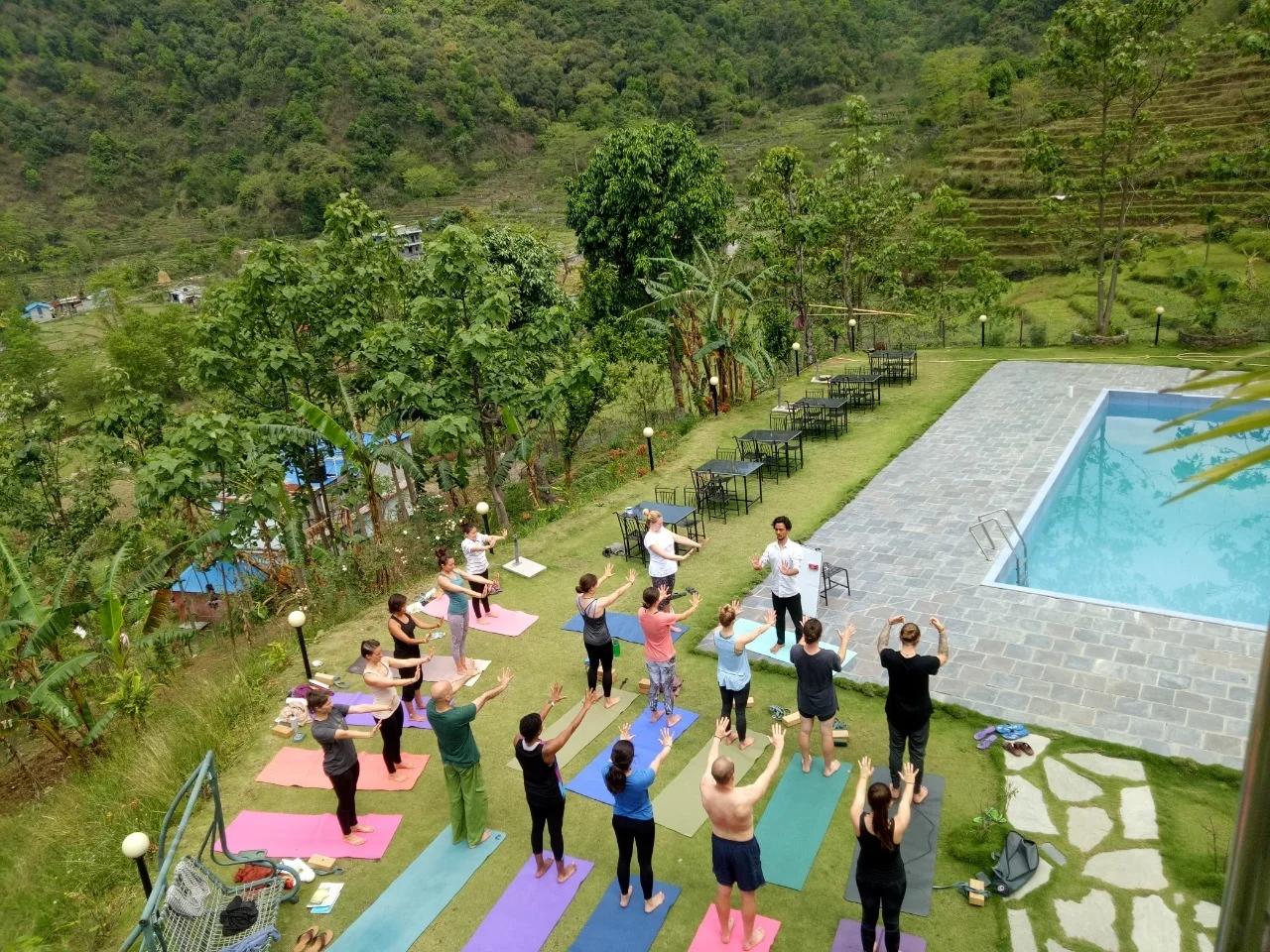
At Pokhara Yoga Academy, we teach sun salutation on day one of every teacher training program, because it is the single practice that most efficiently demonstrates what yoga actually does to a human body and mind over time. This article breaks down the ten most well-documented benefits of sun salutation, explains the physiology and philosophy behind each one, and gives you a clear, safe way to start practicing — whether you’re a complete beginner or a teacher refining your cueing.
Key Takeaways
- Sun salutation is a 12-posture sequence that combines cardiovascular conditioning, strength training, flexibility work, and breath control (pranayama) in a single practice.
- Practicing 5–12 rounds daily can improve cardiovascular fitness, spinal mobility, digestion, and stress resilience within a few weeks.
- Sun salutation is one of the few yoga sequences with published clinical research behind it, including studies on bone density, metabolic markers, and mood.
- It is accessible to beginners but should be modified for pregnancy, high blood pressure, recent surgery, or wrist/shoulder injuries.
- The sequence works because it links movement to breath (vinyasa) — this is what separates it from ordinary stretching or calisthenics.
What Is Sun Salutation? A Quick Primer
Sun salutation is a sequence of 12 linked postures (asanas) performed in a continuous flow, synchronized with inhalation and exhalation. The word Surya means “sun” and Namaskar means “salutation” or “greeting” — traditionally practiced at sunrise, facing east, as both a physical warm-up and a spiritual offering of gratitude to the sun as a source of life energy (prana).
There are several classical variations — Surya Namaskar A and B from the Ashtanga tradition, the Hatha version, and the Sivananda sequence — but all share the same underlying structure: forward folds alternating with backbends, standing poses alternating with floor poses, and a steady rhythm of inhale-expand, exhale-fold.
The Classical 12-Step Sequence
- Pranamasana (Prayer Pose)
- Hasta Uttanasana (Raised Arms Pose)
- Hasta Padasana (Standing Forward Bend)
- Ashwa Sanchalanasana (Equestrian/Lunge Pose)
- Dandasana (Plank Pose)
- Ashtanga Namaskara (Eight-Limbed Salute)
- Bhujangasana (Cobra Pose)
- Adho Mukha Svanasana (Downward-Facing Dog)
- Ashwa Sanchalanasana (Lunge, opposite leg)
- Hasta Padasana (Forward Bend)
- Hasta Uttanasana (Raised Arms Pose)
- Tadasana / Pranamasana (Standing/Prayer Pose)
One full “round” includes this sequence performed twice — once leading with the right leg, once with the left — so that the body is worked evenly on both sides.
Top 10 Excellent Benefits of Sun Salutation
1. Improves Cardiovascular Health and Stamina
Because sun salutation is performed as a continuous flow rather than a series of held static poses, it functions as a mild-to-moderate aerobic exercise. A steady practice of 12 rounds elevates heart rate in a manner comparable to brisk walking or light jogging, gradually building cardiovascular endurance over weeks of consistent practice.
How It Works Physiologically
The rhythmic transition between forward bends and backbends alternately compresses and releases the chest cavity, encouraging deeper, more efficient breathing. Over time, this can support healthier resting heart rate and blood pressure patterns — though anyone with a diagnosed cardiac condition should consult a physician before beginning a vigorous practice.
2. Builds Full-Body Strength Without Equipment
Sun salutation is, in essence, a bodyweight strength sequence disguised as a flow. Plank pose (Dandasana) and the eight-limbed salute (Ashtanga Namaskara) engage the shoulders, triceps, and core. The lunge and forward-fold transitions strengthen the quadriceps, hamstrings, and hip flexors. Cobra pose activates the entire posterior chain — spinal erectors, glutes, and upper back.
Muscle Groups Engaged Per Round
Body Region | Primary Poses Involved |
|---|---|
Shoulders & Arms | Plank, Eight-Limbed Salute, Downward Dog |
Core | Plank, Cobra, Forward Bend |
Legs & Hips | Lunge, Forward Bend, Downward Dog |
Back | Cobra, Raised Arms Pose |
3. Increases Flexibility and Joint Mobility
Each round of sun salutation moves the spine through flexion, extension, and neutral alignment, while simultaneously opening the hips, hamstrings, shoulders, and ankles. Practiced daily, this repeated range-of-motion work is one of the most efficient ways to counteract the stiffness caused by long hours of sitting — a particularly relevant benefit for desk-based professionals and students.
4. Supports Healthy Digestion
The alternating forward folds and backbends create a gentle, rhythmic compression and release across the abdominal organs. This internal “massage” effect is traditionally believed to stimulate digestive fire (Agni) and has been associated in some studies with improved gut motility and reduced bloating when practiced consistently, ideally on an empty stomach in the morning.
5. Aids in Weight Management
Because sun salutation combines strength work, cardiovascular exertion, and continuous movement, it burns a meaningful number of calories per round — the exact number depends on pace, body weight, and the number of rounds performed. Regular practice (25–108 rounds during dedicated practice days, or 12 rounds daily for general fitness) has been linked in preliminary research to improvements in body composition and metabolic markers when combined with mindful eating.
Practitioner note from Pokhara Yoga Academy faculty: Sun salutation supports weight management best as part of a consistent lifestyle — not as an isolated fix. We coach students to pair it with balanced nutrition and adequate sleep for lasting results.
6. Enhances Respiratory Capacity
Every movement in the sequence is linked to a specific inhale or exhale — this is what makes it a vinyasa, not just a stretching routine. Over time, this breath-movement coordination trains the lungs to use their full capacity, deepens diaphragmatic breathing, and can improve overall respiratory efficiency, a benefit particularly valued by singers, athletes, and anyone recovering from sedentary habits.
7. Reduces Stress and Calms the Nervous System
The rhythmic, meditative quality of the sequence activates the parasympathetic nervous system — the body’s “rest and digest” mode — even while the body is working. This is one of the most researched benefits of yoga generally, and sun salutation’s breath-synchronized structure makes it particularly effective as a moving meditation that interrupts stress-response patterns.
Why the Breath-Movement Link Matters
Static exercise (like running or weightlifting) can also reduce stress hormones, but it doesn’t train the nervous system to associate movement with intentional breath control. Sun salutation does both simultaneously, which is why many practitioners report a distinct sense of mental clarity after even a short practice.
8. Improves Posture and Spinal Health
Modern lifestyles — screens, desks, phones — tend to round the shoulders and compress the spine. Sun salutation’s repeated backbends (Cobra, Raised Arms Pose) directly counteract this pattern, strengthening the muscles that support upright posture while improving spinal flexibility. Teachers frequently observe visible postural improvement in students within just a few weeks of consistent daily practice.
9. Balances Hormones and Supports Endocrine Health
Because sun salutation stimulates multiple glandular regions — the thyroid (via neck extension in Cobra pose), the adrenal glands (via the gentle inversion-like quality of Downward Dog), and the reproductive organs (via the compression of Forward Bend) — it is traditionally considered supportive of overall endocrine balance. Anecdotal and some preliminary clinical evidence suggests benefits for menstrual regularity and thyroid function, though this area warrants more rigorous research before strong claims can be made.
10. Cultivates Mental Focus, Discipline, and Mindfulness
Beyond the physical benefits, sun salutation is fundamentally a discipline of attention. Coordinating breath with twelve precise movements, repeated on both sides, trains sustained concentration in a way that few other exercises do. Many practitioners describe their daily sun salutation practice as a form of moving meditation — a structured ritual that builds mental resilience and a sense of accomplishment before the day even begins.
How to Practice Sun Salutation Safely: A Beginner’s Framework
Getting Started
Begin with 3–5 slow rounds, prioritizing proper alignment over speed. It’s far more valuable to move mindfully through 5 rounds than to rush through 20 with poor form.
Building Consistency
Once the sequence feels familiar in the body, gradually build to 12 rounds performed daily, ideally in the morning on an empty stomach. Consistency matters more than intensity — a slow, steady 10-minute daily practice will outperform an occasional 45-minute session.
Who Should Modify or Avoid Sun Salutation
- Pregnancy: Avoid deep forward folds and plank/core-intensive positions after the first trimester; a prenatal-adapted sequence is recommended.
- High blood pressure or cardiac conditions: Practice slowly, avoid rapid transitions, and consult a physician first.
- Recent surgery, hernia, or wrist/shoulder injury: Modify or avoid weight-bearing poses like Plank and the Eight-Limbed Salute.
- Severe back conditions: Work with a qualified teacher to adapt backbends and forward folds safely.
Frequently Asked Questions About Sun Salutation
1. How many rounds of sun salutation should a beginner do daily?
Beginners should start with 3–5 rounds, focusing on breath-movement coordination and alignment. As strength and stamina build over 2–4 weeks, this can gradually increase to 12 rounds for a well-rounded daily practice.
2. What is the best time to practice sun salutation?
Traditionally, sun salutation is practiced at sunrise on an empty stomach, facing east. Practically, any consistent time that fits your schedule works — morning practice tends to energize the body for the day, while evening practice can help release accumulated tension.
3. Can sun salutation help with weight loss?
Yes, when practiced consistently at a moderate pace with a higher number of rounds (12 or more), sun salutation provides a combination of strength and cardiovascular conditioning that supports calorie expenditure and metabolic health, especially alongside balanced nutrition.
4. Is sun salutation suitable for complete beginners with no yoga experience?
Yes. Sun salutation is one of the most beginner-friendly yoga sequences because each pose flows naturally into the next. Beginners should learn it slowly with a qualified teacher first to establish safe alignment before increasing speed or rounds.
5. How long does it take to see benefits from sun salutation?
Many practitioners notice improved energy, mood, and flexibility within 1–2 weeks of daily practice. More measurable changes — such as improved cardiovascular fitness, posture, or body composition — typically become noticeable after 4–8 weeks of consistent practice.
6. What is the difference between Surya Namaskar A and B?
Surya Namaskar A is the classical 12-step sequence described above. Surya Namaskar B, used in the Ashtanga tradition, adds Chair Pose (Utkatasana) and Warrior I (Virabhadrasana I) into the flow, making it more strength-intensive and typically used as a more advanced warm-up.
Bringing Sun Salutation Into a Deeper Yoga Practice
Sun salutation is often a student’s first real yoga sequence — and for good reason. It’s a complete curriculum in miniature: strength, flexibility, breath, and mindfulness, folded into twelve movements that take less than five minutes to complete. But its simplicity is deceptive. Refining alignment, breath timing, and transitions in sun salutation is genuinely a lifelong study, which is exactly why it remains central to how we train teachers at Pokhara Yoga Academy.
If this sequence sparked your curiosity about the deeper mechanics of yoga — anatomy, breath science, sequencing, and how to teach it safely to others — that curiosity is usually the first sign someone is ready for a structured teacher training rather than just a home practice.
Comments are closed