
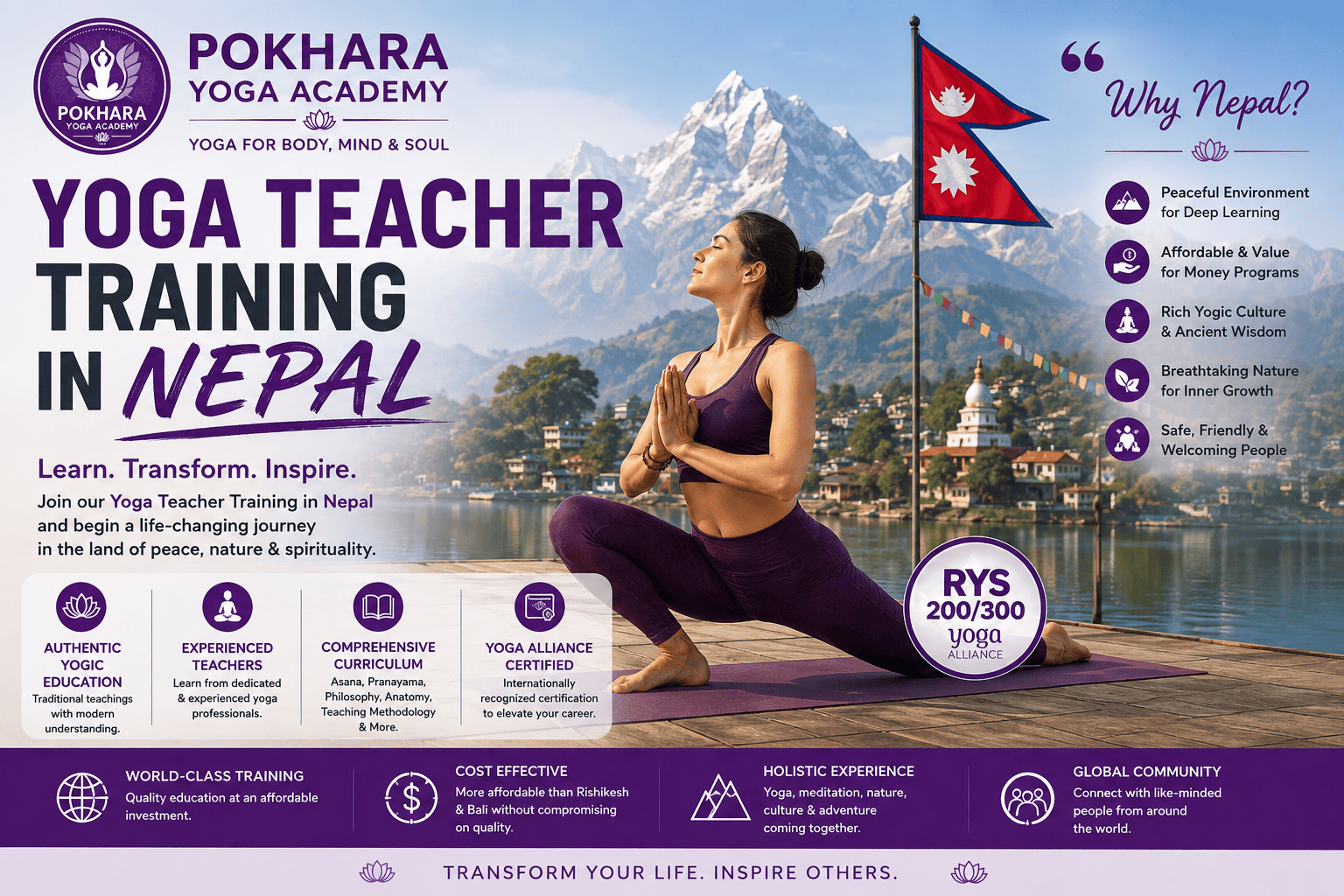
Yoga Teacher Training in Nepal: The Complete Guide to Studying Yoga in the Himalayas
When most people think about traveling abroad for yoga teacher training, Rishikesh, India, or Bali, Indonesia, are usually the first names that come to mind. Nepal — despite sitting in the same Himalayan cultural and spiritual sphere that gave rise to much of yogic tradition — is often overlooked, even though it offers a genuinely compelling, and in many ways superior, environment for serious study.
As a school teaching yoga in Nepal ourselves, based in Pokhara, we’re obviously not a neutral party in this conversation — but we also believe prospective students deserve an honest, detailed picture of what training here actually involves, not just a marketing pitch. This guide covers everything you need to know about pursuing yoga teacher training in Nepal: why the location matters, what a typical program includes, costs, accreditation, and how Nepal genuinely compares to its more famous neighbors.
Key Takeaways
- Nepal offers a unique combination of Himalayan mountain scenery, Hindu-Buddhist spiritual heritage, lower cost of living, and a quieter, less commercialized training environment compared to more saturated yoga destinations.
- Pokhara, Nepal’s second-largest city, has emerged as a major yoga teacher training hub, offering lakeside settings framed by the Annapurna mountain range alongside Kathmandu’s more historically and culturally dense options.
- A standard 200-hour Yoga Teacher Training in Nepal typically runs 3–4 weeks and covers asana, anatomy, philosophy, teaching methodology, and pranayama — aligned with Yoga Alliance international standards.
- Training costs in Nepal are generally lower than in India, Bali, or Thailand for comparable program quality, due to Nepal’s overall lower cost of living, though quality still varies significantly between schools.
- Choosing a Yoga Alliance-accredited school with experienced, ideally Himalayan-region-trained faculty matters more for training quality than the specific city or country chosen.
Why Consider Nepal for Yoga Teacher Training?
The Himalayan Spiritual Context
Nepal is the birthplace of the Buddha and home to some of the world’s most significant Hindu temples and Buddhist monasteries, giving the country a living spiritual and philosophical context that directly informs yogic study — not as a distant historical reference, but as an active, visible culture surrounding daily practice.
A Quieter, Less Commercialized Training Environment
Because Nepal receives a fraction of the yoga tourism traffic that Rishikesh or Bali attract, training environments here tend to be smaller, quieter, and less saturated with the commercial trappings — juice bars, Instagram-oriented studios, tourist-focused pricing — that have increasingly shaped yoga destinations elsewhere. For students seeking a more traditional, less distraction-heavy immersion, this matters considerably.
The Mountain Advantage
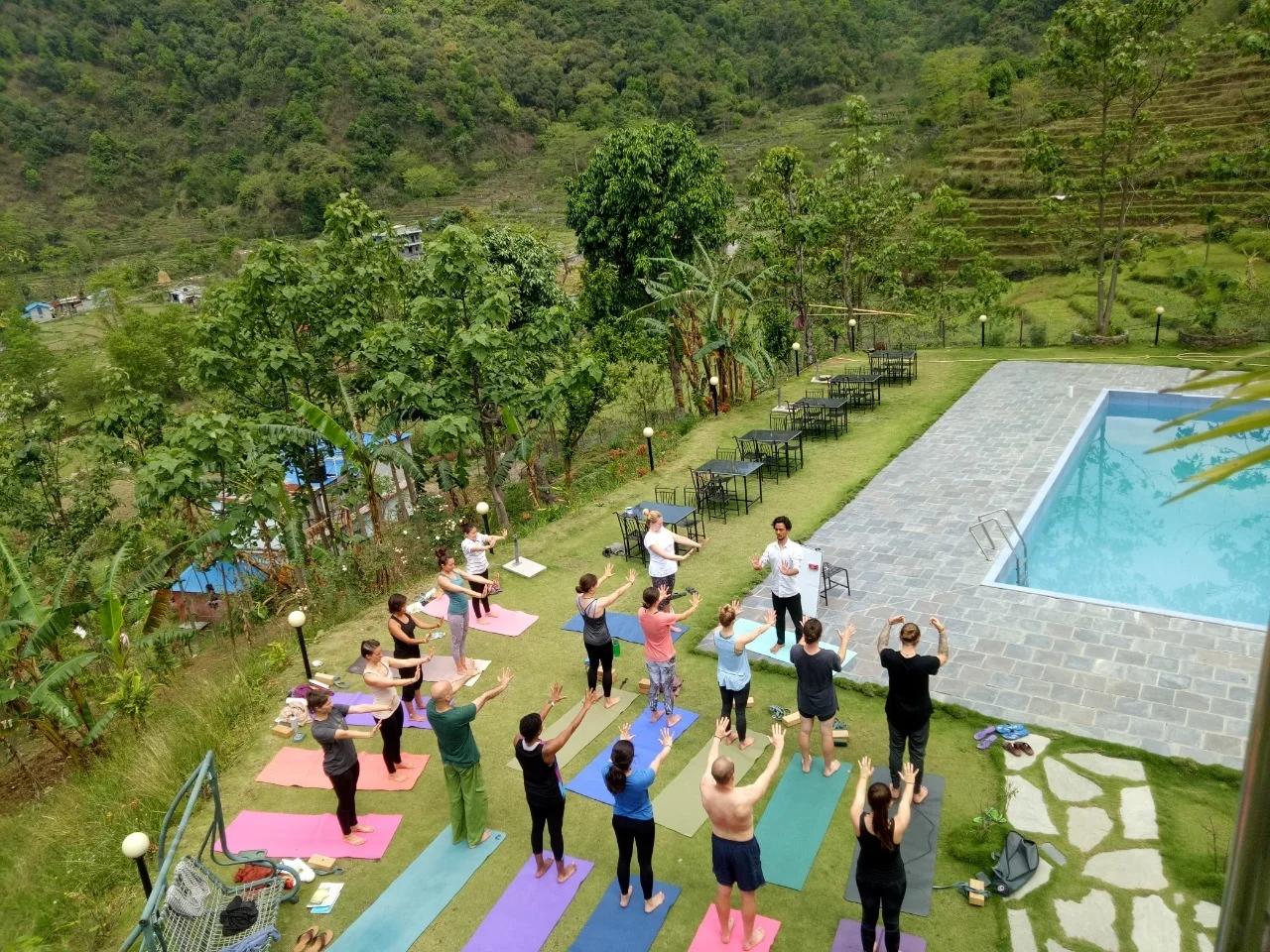
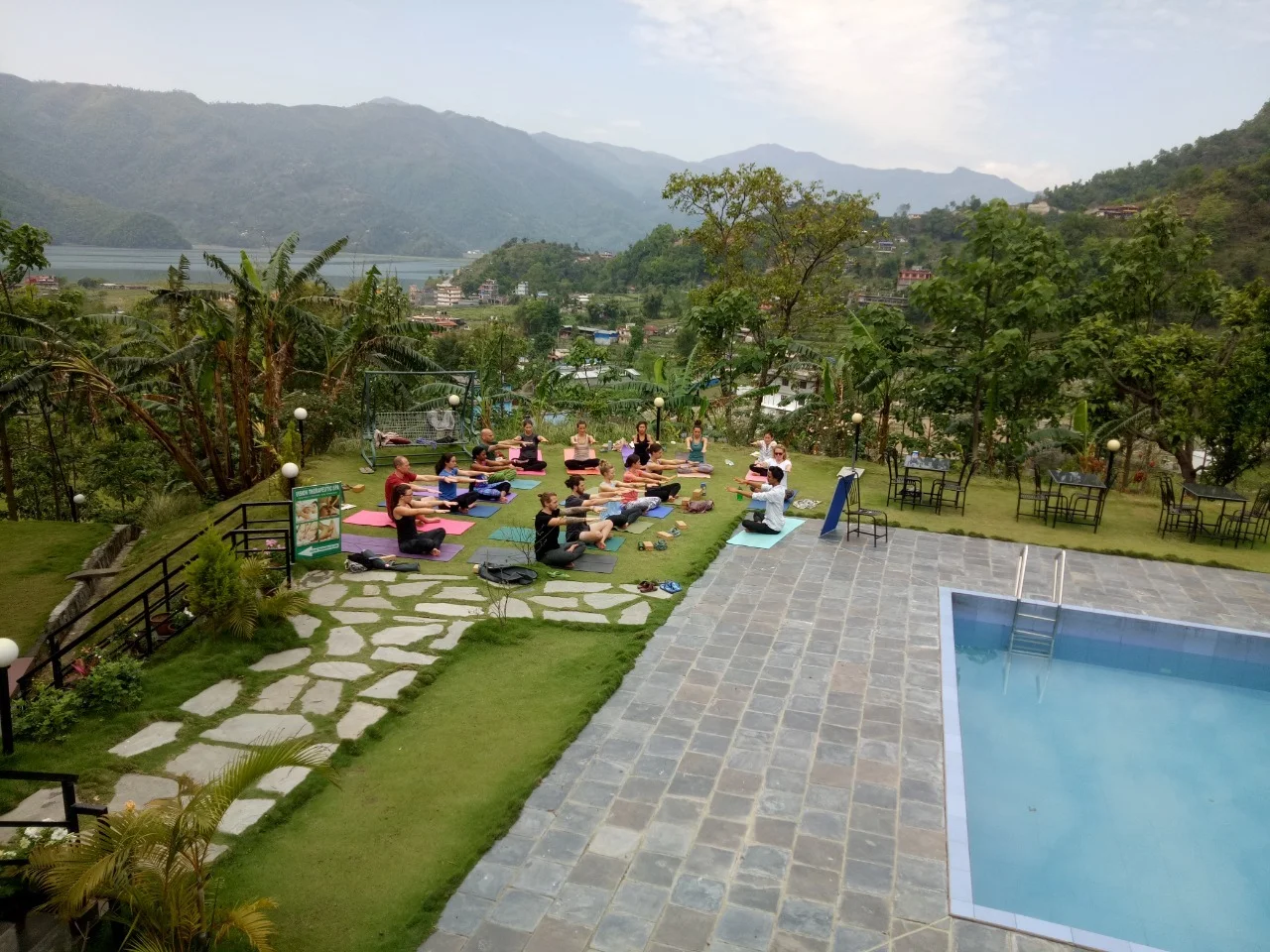
Few training environments anywhere in the world offer daily views of 6,000–8,000 meter Himalayan peaks. In Pokhara specifically, the Annapurna range is visible directly from many training campuses and the shores of Phewa Lake — a setting that meaningfully deepens the meditative and contemplative dimensions of a training that in other locations exist only in lecture form.
Why Environment Actually Affects Learning Outcomes
This isn’t simply an aesthetic point. Environmental psychology research consistently associates exposure to natural landscapes with reduced stress markers and improved sustained attention — both directly relevant to a student’s capacity to absorb dense philosophical and anatomical material over a multi-week intensive training.
Lower Cost Without Sacrificing Quality
Nepal’s overall cost of living is meaningfully lower than India’s major yoga hubs, Bali, or Thailand, which typically translates into lower program tuition, accommodation, and daily living costs for international students — without necessarily compromising curriculum depth or faculty experience, provided the school is properly vetted.
Pokhara vs. Kathmandu: Choosing Your Nepal Training Location
Pokhara: The Lakeside Himalayan Hub
Pokhara has become Nepal’s primary yoga teacher training destination, combining a laid-back lakeside setting on Phewa Lake with direct Annapurna mountain views, a well-established international student community, and significantly better air quality and quiet than Kathmandu’s dense urban environment.
Kathmandu: The Cultural and Historical Center
Kathmandu offers unparalleled access to ancient temples, monasteries, and Nepal’s deepest historical and religious sites, appealing to students who want their training closely woven into visits to significant spiritual landmarks. However, Kathmandu’s traffic, air quality, and urban density can detract from the immersive, contemplative atmosphere many students specifically seek in a training environment.
Which Should You Choose?
For students prioritizing a focused, immersive training experience with strong natural surroundings, Pokhara is generally the stronger choice. For students who want their training combined with deep access to historical and religious sites as a central part of the experience, Kathmandu offers advantages Pokhara cannot fully replicate.
What a Yoga Teacher Training Program in Nepal Typically Covers
Core Curriculum Components (200-Hour Standard)
Curriculum Area | Typical Hours |
|---|---|
Asana practice & alignment | 70–90 hours |
Teaching methodology & practicum | 30–40 hours |
Anatomy & physiology | 20–25 hours |
Yoga philosophy & history | 20–25 hours |
Pranayama & subtle body study | 15–20 hours |
Meditation & mantra | 10–15 hours |
Styles Commonly Offered
Most established schools in Nepal offer training across multiple styles — Hatha, Vinyasa, and Ashtanga most commonly — either as distinct program tracks or blended within a single comprehensive curriculum, allowing students to build a well-rounded foundation rather than specializing prematurely in just one approach.
Program Length Options
- 100-hour programs — a shorter, introductory-level certification, often suited to dedicated practitioners not yet ready for a full 200-hour commitment
- 200-hour programs — the internationally standard foundational teacher certification, typically 3–4 weeks
- 300-hour programs — advanced-level training for already-certified teachers, typically requiring a prior 200-hour credential
- 500-hour programs — often structured as a combined 200+300 hour pathway, representing a comprehensive, advanced teaching credential
A Typical Day in a Nepal Yoga Teacher Training Program
- Early morning meditation and pranayama (5:30–7:00 AM)
- Morning asana practice (7:00–9:00 AM)
- Breakfast
- Anatomy or philosophy lecture (mid-morning)
- Teaching methodology workshop (late morning)
- Lunch and rest
- Afternoon asana or alignment clinic (mid-afternoon)
- Practicum teaching session (late afternoon)
- Evening satsang, self-study, or free time
Many schools also incorporate optional weekend excursions — short Himalayan hikes, visits to nearby temples or monasteries, or free time at Phewa Lake — giving students a chance to experience Nepal’s broader cultural and natural context beyond the training campus itself.
Accreditation: What to Verify Before Enrolling
Yoga Alliance Registration
Confirm that any Nepal-based school holds current Registered Yoga School (RYS) status with Yoga Alliance, the primary international body recognized by studios and employers worldwide. This registration confirms the curriculum meets minimum hour and content standards required for graduates to register as certified teachers internationally.
Verifying a School’s Accreditation Directly
Because accreditation claims are sometimes overstated, prospective students should independently verify a school’s registration status directly through the Yoga Alliance website rather than relying solely on a school’s own marketing claims.
Additional Considerations Beyond Accreditation
- Faculty experience and training lineage — where did the lead teachers themselves train, and for how long have they been teaching?
- Class size and student-to-teacher ratio — smaller cohorts generally allow significantly more individualized feedback
- Alumni outcomes and reviews — independent reviews (Google, TripAdvisor, or direct alumni contact) offer a more reliable picture than a school’s own testimonials page alone
Cost of Yoga Teacher Training in Nepal
What’s Typically Included
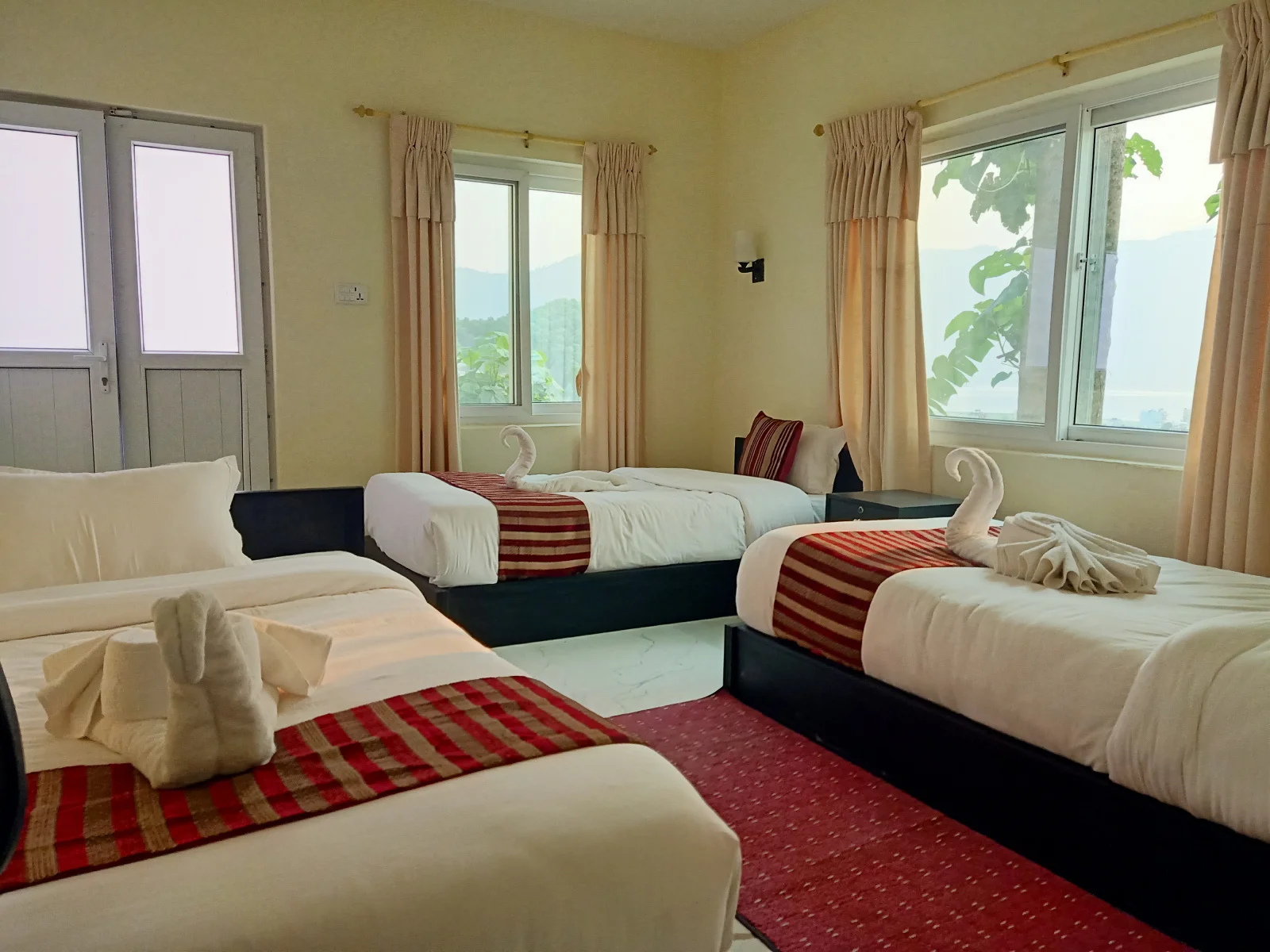
Most comprehensive programs include tuition, shared or private accommodation, and vegetarian meals for the duration of the training — though inclusions vary by school, so confirming exactly what’s covered before booking is essential.
What’s Typically Not Included
- International and domestic flights
- Nepal visa fees (available on arrival for most nationalities)
- Personal excursions or optional weekend trips beyond what’s included in the program
- Personal expenses (laundry, additional snacks, souvenirs)
How Nepal Compares Regionally
Generally, Nepal’s overall training costs run lower than India’s most saturated yoga hubs, Bali, and Thailand for programs of comparable length and quality, largely reflecting Nepal’s lower baseline cost of living rather than any difference in curriculum depth.
Nepal vs. India vs. Bali: An Honest Comparison
Factor | Nepal (Pokhara) | Rishikesh, India | Bali, Indonesia |
|---|---|---|---|
Spiritual/cultural context | Strong (Hindu-Buddhist) | Strong (birthplace of modern yoga) | Moderate (Hindu-influenced) |
Natural setting | Himalayan mountains, lakes | Ganges River, foothills | Tropical, beaches |
Crowd/commercialization level | Lower | Higher (very saturated) | Higher (very saturated) |
Relative cost | Lower | Moderate | Moderate-to-higher |
Visa accessibility | Visa on arrival, most nationalities | e-Visa available | Visa on arrival, most nationalities |
The Honest Takeaway
None of these destinations is objectively “best” — each offers a genuinely different training atmosphere. Rishikesh offers unmatched historical density as yoga’s modern birthplace; Bali offers a wellness-tourism ecosystem with strong post-training community; Nepal offers a quieter, less commercialized immersion with arguably the most dramatic natural scenery of the three. The right choice depends on what kind of environment will actually help you focus and absorb the material.
Who Should Consider Training in Nepal Specifically?
Ideal Candidates
- Students who want a genuinely immersive, less touristy training environment
- Those drawn specifically to Himalayan culture, Buddhist philosophy, or mountain settings as part of their yoga journey
- Budget-conscious students seeking high-quality training at a lower overall cost than India’s most saturated hubs or Bali
- Practitioners who value a smaller, quieter student community over a larger, more socially bustling training scene
Practical Considerations Before Booking
- Altitude — Pokhara sits at roughly 800 meters, a comfortable elevation that doesn’t typically require acclimatization, unlike higher Himalayan trekking regions
- Travel logistics — most international students fly into Kathmandu (Tribhuvan International Airport) and connect via a short domestic flight or scenic overland journey to Pokhara
- Seasonal timing — spring (March–May) and autumn (September–November) offer the clearest mountain views and most comfortable training conditions, while monsoon season (June–August) brings heavier rainfall
From Training to Teaching: Career Paths After Certification in Nepal
Graduates of a Yoga Alliance-accredited program in Nepal carry an internationally recognized RYT (Registered Yoga Teacher) credential, opening the same career pathways as graduates trained anywhere else in the world:
- Teaching at studios, gyms, or wellness centers internationally
- Leading retreats or workshops, drawing on their direct experience of Himalayan training culture as part of their teaching narrative
- Building a private teaching practice or online offering
- Returning to Nepal for advanced (300-hour or 500-hour) training to deepen specialization
Frequently Asked Questions About Yoga Teacher Training in Nepal
1. Is Nepal a good place for yoga teacher training?
Yes. Nepal offers a strong Himalayan spiritual and cultural context, dramatic natural scenery, generally lower costs than neighboring yoga destinations, and a quieter, less commercialized training environment — particularly in Pokhara, which has become a well-established international training hub.
2. How much does yoga teacher training in Nepal cost?
Costs vary by school and program length, but Nepal’s training costs are generally lower than comparable programs in India’s most saturated hubs, Bali, or Thailand, largely due to Nepal’s lower overall cost of living. Most comprehensive programs include tuition, accommodation, and meals.
3. Do I need a visa to attend yoga teacher training in Nepal?
Most nationalities can obtain a Nepal visa on arrival at Kathmandu’s international airport or land border crossings. Requirements vary by country, so confirming current visa policy before travel is recommended.
4. Is Pokhara or Kathmandu better for yoga teacher training?
Pokhara generally offers a quieter, more immersive training environment with direct Himalayan mountain views and better air quality, while Kathmandu offers deeper access to historical and religious sites. The better choice depends on whether a student prioritizes natural immersion or cultural-historical density.
5. How does Yoga Teacher Training in Nepal compare to Rishikesh, India?
Both offer strong spiritual and cultural context rooted in Himalayan and Hindu-Buddhist tradition. Rishikesh is more historically established as yoga’s modern birthplace and tends to be more commercialized and crowded, while Nepal — particularly Pokhara — offers a comparable depth of training with a quieter, less saturated environment and generally lower costs.
6. Is a Yoga Teacher Training certificate from Nepal recognized internationally?
Yes, provided the school holds current Yoga Alliance Registered Yoga School (RYS) accreditation. This certification is recognized internationally regardless of the country where training took place, since it reflects adherence to global curriculum standards rather than a country-specific credential.
Why Study Yoga Teacher Training in Nepal at Pokhara Yoga Academy
Choosing where to complete your yoga teacher training is as much about the environment that will shape your learning as it is about the curriculum itself. Nepal offers something genuinely distinct — a living Himalayan spiritual context, dramatic natural surroundings, and a training atmosphere still largely free of the commercialization that has reshaped more saturated yoga destinations elsewhere.
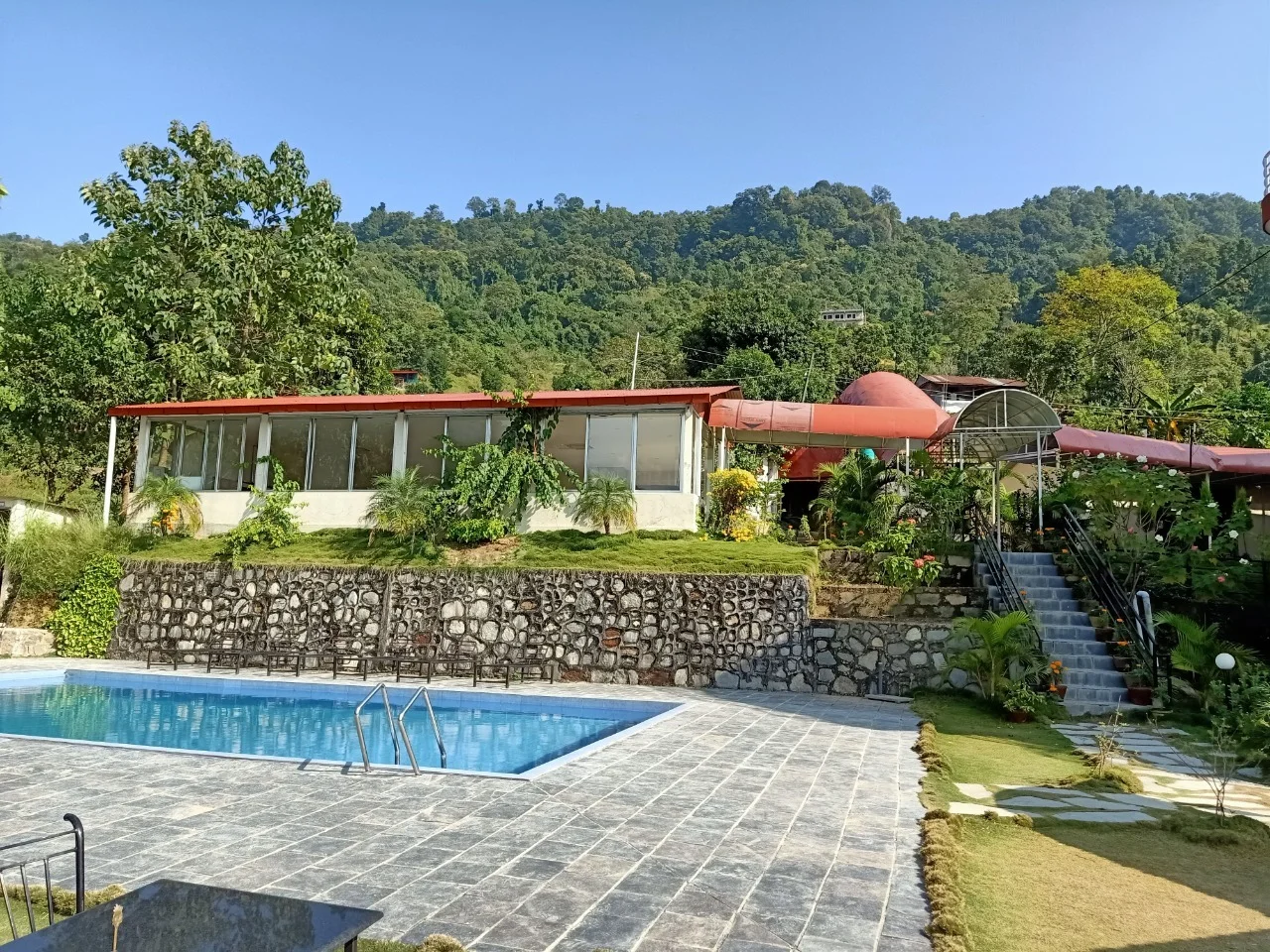
At Pokhara Yoga Academy, our programs combine internationally accredited curriculum standards with the specific advantages of training in the Himalayas — lakeside campuses framed by the Annapurna range, experienced faculty rooted in the region’s yogic and Buddhist traditions, and a small-cohort environment built for genuine individual attention. For students seeking a training experience that’s rigorous, authentic, and genuinely different from the more crowded paths, Nepal — and Pokhara specifically — deserves serious consideration.

Comments are closed